








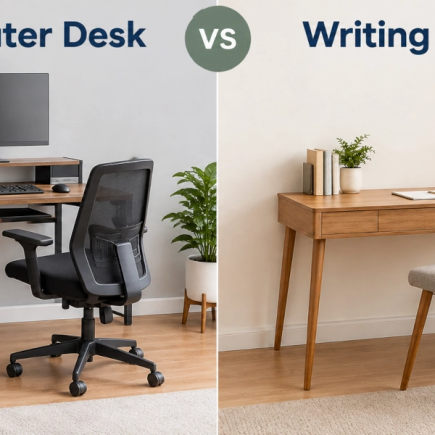










Choosing between an L-shaped desk and a straight desk can be a challenging decision. The right desk will affect your workspace, productivity, and overall comfort. This guide offers a detailed comparison of both desk types, focusing on their space efficiency, ergonomics, storage, and other key aspects, ensuring you make a practical, well-informed decision.
Space Efficiency
L-Shaped Desk
- Maximizes corner space: Ideal for rooms with underutilized corner areas, L-shaped desks offer extra workspace without taking up additional room.
- Creates a designated workspace: Perfect for separating tasks like computer work, paperwork, or brainstorming, and keeping materials within arm’s reach.
- Larger footprint: While they require more space than a straight desk, their corner design frees up the rest of the room for movement.
Straight Desk
- Flexible placement: Can be placed against any wall or in the center of a room, making it suitable for a variety of office layouts.
- Great for smaller rooms: Takes up less space overall and is easier to fit in rooms where corner space is unavailable.
- Simplicity: Offers a clean and streamlined look, great for minimalist designs.
Ergonomics
L-Shaped Desk
- Improves posture: The ability to create multiple work zones encourages better posture by reducing the need for reaching or twisting.
- Customizable setup: You can position your main work tools and monitors in the corner, with a secondary area for papers and reference materials.
- Switchable workstations: Allows you to alternate between sitting and standing positions without disrupting your workflow.
Straight Desk
- Simple ergonomics: Ideal for focused, single-task work with everything placed in front of you for easy access.
- Easy to optimize: Can be equipped with accessories like adjustable chairs, monitor arms, and keyboard trays to improve comfort.
- Less movement: Limited ability to move between work zones, which may cause discomfort if you’re working for long hours.
Storage and Organization
L-Shaped Desk
- More built-in storage: Many L-shaped desks come with integrated drawers, shelves, or even cubby spaces to keep items organized.
- Separate task zones: Having two sides to the desk means you can create clear boundaries between different tasks, which helps in keeping things organized.
- Cable management: The corner design provides an easy spot to route and hide cables, reducing clutter and promoting a cleaner workspace.
Straight Desk
- Limited built-in storage: Straight desks are typically simpler, so you’ll need to add storage solutions like filing cabinets or shelves.
- Focused workspace: A straightforward, clean design encourages keeping only the essentials within reach, reducing potential clutter.
- External storage: Easily pairs with external storage units to keep the main desk surface tidy.
Aesthetic Appeal
L-Shaped Desk
- Modern and bold design: L-shaped desks have a distinctive look that can define the style of your entire office.
- Professional appearance: Often used in corporate settings, L-shaped desks exude a sense of authority and organization.
- Space partitioning: Their design helps divide the workspace into distinct zones, offering both practicality and a visual aesthetic.
Straight Desk
- Timeless appeal: Straight desks fit into any office style, from traditional to contemporary, offering flexibility in design.
- Simple and minimalist: Ideal for creating a streamlined look, straight desks offer a neutral canvas that works well in any setting.
- Versatile in décor: A straight desk blends into the background, making it perfect for smaller or shared spaces.
Cost-Effectiveness
L-Shaped Desk
- More expensive: Due to their size, shape, and added features like multiple storage options, L-shaped desks are typically pricier.
- Long-term investment: The higher cost is often justified by the added workspace, versatility, and ergonomic benefits, especially for multitaskers.
- Shipping and installation costs: Larger and bulkier than straight desks, L-shaped desks tend to incur higher shipping and assembly costs.
Straight Desk
- Affordable options: Straight desks are often more budget-friendly, especially when compared to L-shaped models.
- Wide range of prices: Available in various price points, straight desks can fit nearly any budget while still providing ample functionality.
- Minimalist appeal: If you don’t need extensive features, a straight desk can provide a cost-effective and functional solution.
Versatility
L-Shaped Desk
- Perfect for multitasking: Offers a spacious work area to separate tasks like computer work, writing, or project management.
- Customization options: L-shaped desks often allow for flexible layouts and can be configured to fit different room sizes and shapes.
- Limitations in rearranging: Once placed in a corner, it may be difficult to move or adjust the desk’s layout without disrupting the overall design.
Straight Desk
- Easy to move: Ideal for individuals who frequently change their office setup or work in shared spaces.
- Ideal for small, simple setups: Works well for users who need a straightforward, uncluttered desk setup.
- Great for collaborative workspaces: The open design makes straight desks perfect for collaborative environments, where multiple people might need to gather around.
L-Shaped Desk vs Straight Desk
| Feature | L-Shaped Desk | Straight Desk |
| Space Efficiency | Maximizes corner space, freeing up the central room area. | Fits in a variety of places but may take up more linear wall space. |
| Ergonomics | Better for multitasking and reducing physical strain by offering access to multiple work zones. | Simpler ergonomic setup, best for single-tasking and straightforward work. |
| Storage Solutions | Offers more built-in storage, great for organizing multiple tools and materials. | Generally has less built-in storage but can be paired with external solutions. |
| Cost Comparison | Typically more expensive due to size and complexity. | More affordable, with a range of options for every budget. |
| Flexibility and Adaptability | Great for larger spaces but harder to rearrange. | Easy to move and fit into various office layouts, ideal for smaller spaces. |
| Aesthetic Appeal | Modern, professional, and commanding. | Simple and versatile, fits into any room style. |
| Storage Organization | More space for organization and efficient task separation. | Less storage space but encourages minimalist organization. |
| Work StyleSuitability | Best for multitaskers and those who need multiple work zones. | Ideal for single-taskers and those looking for a clean, focused workspace. |
When to Choose an L-Shaped Desk
If your work involves multitasking, using multiple monitors, or if you need to manage different types of tasks simultaneously, the L-shaped desk is a practical choice. It’s also ideal if you have a medium to large space that can accommodate the extended shape.
Best for:
- Multi-taskers
- Those who need multiple screens or documents
- Larger workspaces
When to Choose a Straight Desk
If you work in a smaller office or prefer a more minimalistic approach, a straight desk will suit your needs perfectly. It’s also a more cost-effective choice if you have a simple workflow or limited space.
Best for:
- Single-taskers
- Smaller workspaces
- Those on a budget
Finding Your Perfect Desk
Choosing between an L-shaped desk and a straight desk depends on your specific workspace needs, ergonomics, and budget. When exploring different Computer Desks, an L-shaped desk is a great option if you value space, multitasking, and organization. For a more budget-friendly, flexible, and simple setup, a straight desk remains the perfect choice
FAQs
To make the most of an L-shaped desk in a small space, position it in a corner to free up floor space. Consider wall-mounted shelves to further maximize storage without crowding the room.
Yes! L-shaped desks allow you to separate work tasks, creating dedicated zones for different activities. This separation can boost productivity and help you stay organized during complex projects.
Straight desks offer a sleek, simple look that fits seamlessly into minimalist office designs. Their straightforward layout enhances a clean and clutter-free aesthetic, perfect for small spaces.