



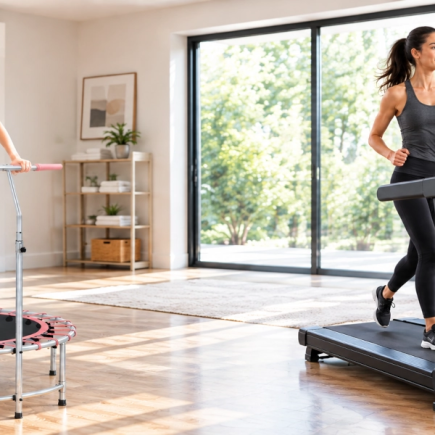













When it’s -25°C outside and the sidewalks are a sheet of ice, getting your cardio in at home starts to look pretty appealing. For many Canadians, the choice for home cardio comes down to two options: a rebounder (a mini fitness trampoline) or a treadmill.
Both will get your heart rate up, but they differ a lot in space, joint impact, cost, and noise. That last one matters if you’re in a condo or have a neighbour downstairs. In this guide, we compare the rebounder vs treadmill honestly, without the sales pitch, so you can pick the one that suits your goals and your home.
Rebounder vs Treadmill: Quick Comparison
| Feature | Rebounder | Treadmill |
| Space needed | Small, folds or stores easily | Large, roughly 2 m of floor length |
| Joint impact | Low | Moderate to high (when running) |
| Calorie burn | Moderate to high | Moderate to very high |
| Noise | Quiet (especially bungee models) | Motor hum and footstrikes |
| Workout variety | High | Walking, running, incline |
| Electricity | Not needed | Needed |
| Best for | Joint-friendly, fun, small-space cardio | Runners and high-intensity training |
What Is a Rebounder?
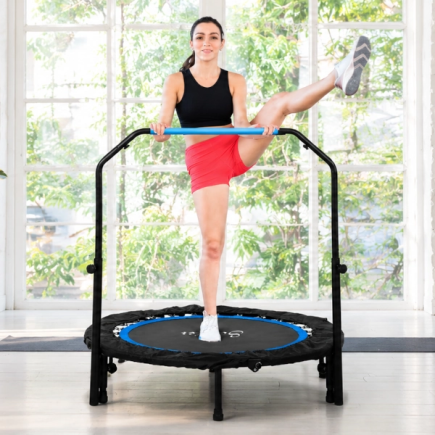
A Rebounder is a small, sturdy trampoline, usually about 90 to 125 cm (36 to 50 inches) across, built for fitness rather than backyard play. You can bounce gently, jog on the spot, do jumping jacks, or follow guided rebounding classes. Many models come with a stabilizing handlebar, which helps beginners and older adults.
Rebounders use either steel springs or bungee cords. Bungee models tend to be quieter and give a softer bounce.
A rebounder isn’t the same as a backyard trampoline. It’s designed for controlled, low-height movements, which is why people searching “trampoline vs treadmill” are usually comparing a Mini Trampoline to a treadmill.
Benefits of a Rebounder
A rebounder packs a lot of value into a small piece of equipment, especially for anyone who wants gentle, enjoyable cardio at home.
- Low impact on joints.
- Affordable and compact.
- Quiet, so it’s good for condos and apartments.
- May improve balance and coordination.
- Fun, which helps you stay consistent.
- No electricity needed.
What Is a Treadmill?
A Treadmill is a motorized machine with a moving belt that lets you walk, jog, or run indoors. Most home models let you adjust speed and incline, and many include preset programs, heart rate tracking, and subscription-based training apps.
Benefits of a Treadmill
A treadmill is a reliable choice for anyone who loves walking or running and wants to keep training no matter what the Canadian weather brings.
- Ideal for runners training for races, such as a spring 10K or marathon.
- Precise tracking of speed, distance, and incline.
- Weight-bearing exercise that supports bone health.
- Higher intensity potential with speed and incline.
- Keeps your running routine going through winter.
Drawbacks to Consider
Rebounder: It’s harder to track distance and pace, so it’s less useful for race training. People with serious balance issues should choose a model with a handlebar. Cheap models can feel wobbly or squeaky.
Treadmill: It’s expensive, bulky, and noisy, and it needs electricity. Running can be tough on the joints, and some people find it repetitive.
Space, Storage, and Condo Living
Treadmills are big. Even folding models need roughly 2 metres of floor length plus clearance behind them, and many weigh 70 to 140 kg (150 to 300 lb). Getting one up a condo elevator or down to the basement can be a project in itself.
Rebounders are compact and light. Many fold in half or have removable legs, so you can slide one under a bed or into a closet. They’re also much quieter, especially bungee models, which makes them a good fit for apartments and condos where your downstairs neighbour will hear every footstrike on a treadmill.
Cost
This is one of the biggest differences between the two.
Rebounders are generally far more affordable than treadmills. Even premium models with handlebars and bungee systems usually cost much less than a mid-range treadmill. Budget rebounders are cheaper still, but quality varies, so it’s worth choosing a sturdy model.
Treadmills are a bigger investment. Beyond the purchase price, you’ll also pay for electricity, maintenance such as belt lubrication, and possibly a monthly app subscription for guided workouts.
If budget is a priority, the rebounder is the clear winner.
Impact on Your Joints and Balance
This is where the rebounder shines. The springy mat absorbs much of the shock that would otherwise travel through your ankles, knees, and hips.
That makes rebounding a popular option for:
- People with joint pain or mild arthritis.
- Beginners and people returning to exercise.
- Older adults.
- Anyone who finds running uncomfortable.
Research also suggests rebounding may help with balance and strength. In a randomized controlled trial, women aged 56 to 83 with osteopenia did balance, strength, and jumping exercises on a mini trampoline twice a week for 12 weeks. The group showed significant improvements in balance, mobility, strength, walking speed, fear of falling, and bone density at the hip.[1]
Walking on a treadmill is low impact, and a cushioned deck is easier on your body than running outside on frozen pavement. Running on a treadmill still involves impact with every stride, though. If you have knee, hip, or back issues, a rebounder is usually more comfortable. Check with your doctor or physiotherapist first.
Calorie Burn: Which One Burns More?
This is the question everyone asks, and the honest answer is that it depends on how hard you work.
Research suggests that a vigorous rebounding session can burn about as many calories as a moderate run, even though rebounding often feels easier.
On a treadmill, calorie burn depends on speed and incline. A brisk walk might burn around 4 to 6 calories per minute for an average adult, while running can burn 10 to 15 or more. Adding incline raises the burn even at walking speed.
Is rebounding really “68% more efficient” than running?
You may have come across this popular claim. It’s linked to a 1980 NASA study that compared trampoline jumping with treadmill walking and running in eight young men.[2] The researchers found that at similar heart rates and oxygen uptake, jumping on a trampoline put a greater physical stimulus on the body than running. The 68% figure is often quoted from this research, but it isn’t part of the study’s main findings. The study also used a full-size competition trampoline, not a mini rebounder, and was designed to help astronauts, not home exercisers. It’s an interesting result, but it doesn’t prove rebounding burns more calories than running.
What this means for you: For everyday fitness, either machine can give you a solid calorie burn. If you want to push to very high intensity with sprints or steep incline walking, a treadmill gives you more room to go harder. (Calorie burn varies depending on your body weight, fitness level, and effort.)
Workout Variety
A treadmill is excellent for walking and running. You can change speed, incline, and intervals, but the basic movement stays the same, which some people find boring over a long winter.
A rebounder offers more variety.
You can do:
- A basic health bounce.
- Jogging on the spot.
- Jumping jacks.
- High knees.
- Twists.
- Light strength moves with hand weights.
Adding hand weights to your rebounding routine is also an easy way to build some muscle-strengthening work into your cardio. Many people find rebounding more fun, and that makes it easier to stick with through the colder months.
How Much Cardio Do Canadians Need?
The Government of Canada recommends that adults get at least 150 minutes of moderate-to-vigorous physical activity per week, along with regular muscle- and bone-strengthening activities.[3] That works out to about 30 minutes, five days a week.
Both a rebounder and a treadmill can help you reach that 150-minute goal from home, whatever the weather is doing outside. You can also split it into shorter sessions, such as three 10-minute bounces a day, which makes it easier to fit into a busy schedule.
Which One Should You Choose?
Choose a rebounder if you:
- Have joint pain or want low-impact cardio.
- Live in a condo, apartment, or small space.
- Are on a budget.
- Want a fun, varied workout.
- Are a beginner or older adult.
Choose a treadmill if you:
- Are training for a race or want to improve your running.
- Want to keep your running routine going through winter.
- Want precise workout tracking.
- Have the space and budget.
Can you use both? Absolutely. Many people use a treadmill for longer steady cardio and a rebounder for quick, low-impact sessions or active recovery days.
Bounce or Run? Our Honest Take
In the rebounder vs treadmill debate, there’s no single winner. If you want an affordable, compact, quiet, and joint-friendly way to stay active through a Canadian winter, a rebounder is hard to beat. If you’re a runner or want maximum intensity and precise tracking, a treadmill is the better investment.
Whichever you choose, the best cardio machine is the one you’ll actually use regularly. Ready to make home workouts part of your routine this winter? Pick the option that fits your space and goals, and start moving today.
FAQs
You can, as long as you also eat a balanced diet. Thirty minutes of daily cardio on either machine burns extra calories and builds fitness, but lasting weight loss depends on your overall habits, not exercise alone.
Not directly. Exercise generally burns fat from all over your body rather than from one chosen spot. Regular cardio on either machine, combined with strength training and a balanced diet, helps reduce belly fat over time.
Not quite. A walking pad is a slim, compact treadmill built mainly for walking. Many top out around 6 km/h (4 mph) and lack incline, so they save space but aren’t well suited to running like a full-size treadmill.
On a treadmill, wear supportive running or walking shoes. On a rebounder, you can bounce barefoot, in grip socks, or in light athletic shoes. Avoid regular socks on either machine, since they can slip and cause a fall.
It depends on the model. Most home rebounders and treadmills support about 100 to 150 kg (220 to 330 lb), though some compact models hold less. Check the maximum user weight and choose one rated above your own weight.
References
[1] Posch M, et al. (2019). Effectiveness of a Mini-Trampoline Training Program on Balance and Functional Mobility, Gait Performance, Strength, Fear of Falling and Bone Mineral Density in Older Women with Osteopenia. Clinical Interventions in Aging.
https://pmc.ncbi.nlm.nih.gov/articles/PMC6929928
[2] Bhattacharya A, et al. (1980). Body acceleration distribution and O2 uptake in humans during running and jumping. Journal of Applied Physiology.
https://ntrs.nasa.gov/citations/19810029519
[3] Government of Canada. Physical activity: Being physically active for your health.
https://www.canada.ca/en/public-health/services/being-active/physical-activity-your-health.html