



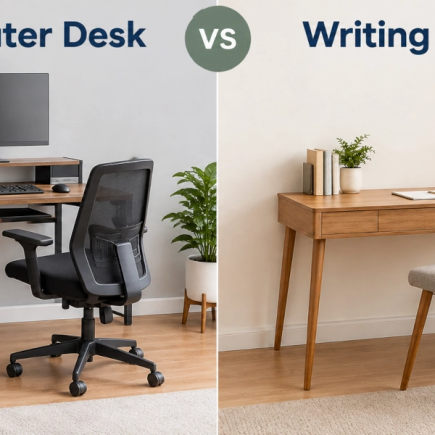
























A writing desk is a simple, open desk for laptops, reading and paperwork. A computer desk is built around a full computer setup, with features such as shelves, a keyboard tray, cable holes, built-in power outlets and a higher weight capacity.
Many desks are sold as both, so compare features and specifications rather than the product name. Choose a writing desk for laptop work, study or small spaces, and a computer desk for monitors, a desktop PC or gaming.
Computer Desk vs Writing Desk: Comparison Table
| Feature | Writing Desk | Computer Desk |
| Main use | Laptop work, reading, handwriting, study | Monitors, desktop PCs, gaming, long screen sessions |
| Typical width | 32–47 in (80–120 cm) | 39–71 in (100–180 cm); gaming and L-shaped desks larger |
| Typical depth | 18–24 in (45–60 cm) | 19–28 in (48–70 cm) |
| Typical height | 28–30 in (72–76 cm) | 28–30 in (72–76 cm), or height-adjustable |
| Storage | None or 1–2 drawers | Drawers, open shelves, cabinets, file drawers |
| Computer features | Rarely included | Keyboard tray, monitor shelf, cable holes, power outlets and USB ports |
| Weight capacity | Lower | Higher, especially on L-shaped and steel-frame desks |
| Style | Minimalist, modern, farmhouse | Modern, industrial, executive, gaming |
Ranges reflect common home office desks, not fixed standards. Always check the assembled dimensions and weight capacity of a specific desk.
What Is a Writing Desk?
A Writing Desk is a simple desk with an open work surface for one person. It usually has a flat top on legs or a light frame, with no storage or just one or two drawers. Today it is mostly used as a laptop, study or homework desk.
Common types of writing desks
- Table-style desk: A plain top on four legs, the most minimalist option.
- Writing desk with drawers: Adds one or two drawers for stationery and papers.
- Wall-mounted or fold-out desk: Folds flat against the wall to save floor space.
- Drafting or craft desk: Has a tilting top for drawing, painting or sketching.
Advantages of a writing desk
- Compact footprint that fits bedrooms, residence rooms and small apartments.
- Lightweight, so it is easy to move or rearrange.
- Simple assembly and usually a lower price.
- Open knee space for comfortable seating.
Limitations of a writing desk
- Limited room for a monitor, PC tower or accessories.
- Little or no storage for files and supplies.
- No built-in cable management, so wires stay visible.
What Is a Computer Desk?
A Computer Desk is a desk designed to hold a complete computer setup like monitor, keyboard, mouse, PC tower or laptop, and cables. It adds features that make daily screen work more organized and comfortable.
Common types of computer desks
- Computer desk with storage: Includes drawers, open shelves or a cabinet beside the legroom.
- L-shaped or corner desk: Two work surfaces for screens on one side and paperwork on the other.
- Executive desk: A larger desk with multiple drawers, often including a file drawer for letter-size documents.
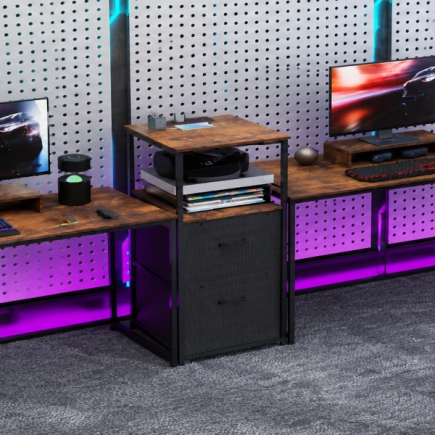
- Gaming desk: A wide desk with cable holes, headphone hooks, cup holders and sometimes LED lighting.
- Standing or height-adjustable desk: Lets you switch between sitting and standing.
- Folding computer desk: Folds away when not in use, ideal for small apartments.
Advantages of a computer desk
- Keeps monitors, keyboard and devices organized in one place.
- Built-in storage reduces the need for extra shelves or cabinets.
- Features such as keyboard trays and monitor shelves support better posture.
- Cable holes and power outlets make charging and wiring easier.
Limitations of a computer desk
- Takes up more floor space, especially L-shaped and gaming models.
- Heavier and takes longer to assemble.
- Side drawers or shelves can reduce knee space.
Difference Between Computer Desk or Writing Desk
Computer desks and writing desks differ in six main ways such as purpose, computer features, storage, size, weight capacity and style.
1. Purpose
A writing desk gives you a clear surface for light tasks. A computer desk is organized around screens and devices.
2. Computer features
Computer desks often include a keyboard tray, monitor shelf, cable holes, and built-in power outlets or USB charging ports. Writing desks rarely have these.
3. Storage
Writing desks keep storage minimal to stay light and open. Computer desks commonly add shelves, several drawers or cabinets for files and accessories.
4. Size
Writing desks are typically narrower, from about 32 in (80 cm). Computer desks often start around 39 in (100 cm), and gaming or L-shaped models can reach 79 in (200 cm) wide.
5. Weight capacity
Compact desks may be rated for around 44 lb (20 kg), while larger L-shaped computer desks can hold 220 lb (100 kg) or more. Check the rating against your monitors, PC and accessories.
6. Style and placement
Writing desks blend easily into bedrooms, living rooms and residence rooms. Computer desks suit a home office, study or gaming room.
Which Desk Should You Choose?
The right desk depends on your equipment, your space and how long you work each day.
| Your situation | Better choice |
| Laptop only or part-time work | Writing desk |
| Students, homework and reading | Writing desk |
| Drawing, sketching or crafts | Drafting or craft desk |
| Small bedroom or apartment | Writing desk, wall-mounted or folding desk |
| Laptop plus one monitor | Computer desk or a writing desk with enough depth |
| Dual monitors or desktop PC | Computer desk, 55 in (140 cm) or wider |
| PC gaming | Gaming desk |
| Work plus lots of paperwork | L-shaped or executive computer desk |
| Full-time remote work | Height-adjustable computer desk |
Recommended Desk Sizes by Setup
Desk size should match the equipment you use every day, not just the space available.
| Setup | Width | Depth |
| Laptop and notebook | 32–39 in (80–100 cm) | 18–22 in (45–55 cm) |
| Laptop or one monitor | 39–47 in (100–120 cm) | 20–24 in (50–60 cm) |
| One monitor plus paperwork | 47–55 in (120–140 cm) | 22–26 in (55–65 cm) |
| Two monitors | 55–63 in (140–160 cm) | 24 in (60 cm) or more |
| Gaming or three screens | 63–79 in (160–200 cm) or L-shaped | 24–28 in (60–70 cm) |
For comfortable viewing, keep your monitor about an arm’s length away, with the top of the screen at or slightly below eye level. A monitor shelf or monitor arm helps on shallower desks. Leave about 36 in (90 cm) behind the desk to move your chair.
Best Materials for Computer Desks and Writing Desks
Most home desks use engineered wood, sometimes with a steel frame for extra support.
| Material | Best for |
| MDF or particleboard with melamine finish | Writing and computer desks; smooth, scratch-resistant and easy to wipe clean |
| Steel or metal frame | Computer, gaming and industrial desks that carry heavier equipment |
| Solid wood | Rustic, farmhouse or natural-look desks |
Colour names such as “oak”, “walnut” or “wood grain” usually describe the finish, not the material, so check the material and weight capacity in the specifications.
Desk Buying Checklist
Check these details before choosing a desk:
- Measure your space, including walkways and chair clearance.
- Measure your equipment, especially the combined width of your monitors.
- Check assembled dimensions (width × depth × height), not package size.
- Check knee space if the desk has drawers or shelves on one side.
- Compare weight capacity with the total weight of your setup.
- Look for the features you need like keyboard tray, cable holes, power outlets or file drawers.
- For L-shaped desks, confirm the left or right orientation, or whether it is reversible.
Computer Desk vs Writing Desk: Which Is Right for You?
Choose a writing desk for laptop work, study and small spaces. Choose a computer desk for monitors, a desktop PC or gaming. Either way, compare features and specifications, not product names.
Ready to set up your workspace? Explore the full range of computer desks and writing desks at Aosom Canada and find the right fit for your home office, bedroom or study.
FAQs
Yes, if it is wide and deep enough for your monitor and keyboard and rated for your equipment’s weight. Adding a monitor arm, an under-desk cable tray and a floor CPU stand can help a writing desk work like a computer desk.
Yes. Most computer desks suit writing, studying and paperwork because they offer extra surface space and storage. If the desk has a keyboard tray, write on the main desktop, as the tray sits lower than a comfortable writing height.
A gaming desk is a wider computer desk built for long gaming sessions, often with cable holes, headphone hooks, cup holders and LED lights. A standard computer desk focuses on work storage such as drawers, shelves and keyboard trays.
An L-shaped desk is usually classed as a computer desk, but it works as both. One side can hold monitors and a keyboard, while the other stays clear for writing, reading or paperwork, giving you separate zones for different tasks.
For a desk 28–30 in (72–76 cm) high, most people need a chair seat height of about 17–21 in (43–53 cm). Adjust it so your feet rest flat on the floor, your elbows are level with the desktop and your thighs clear the underside.