












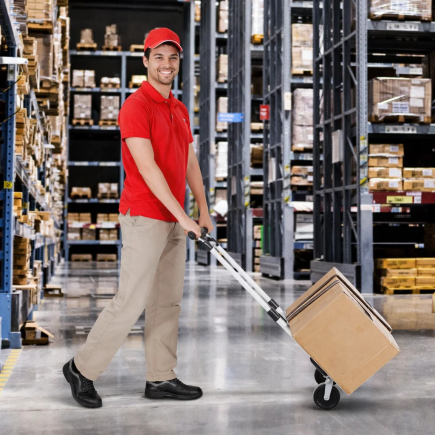
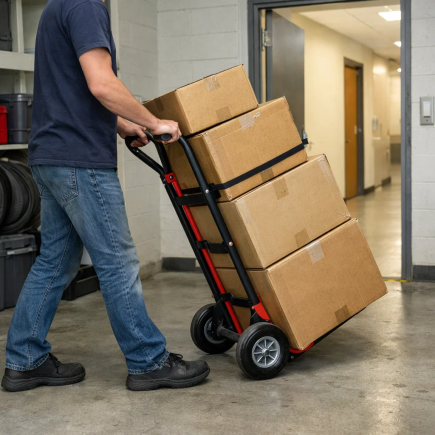



















Your back is not built for lifting heavy boxes repeatedly. Neither is it designed to carry a washing machine across a room or haul stacks of supply crates down a corridor. This is exactly why the hand truck exists. It is a simple, clever tool that uses basic physics to take the strain off your body and put it onto the wheels.
But just having a hand truck is not enough. Using it the wrong way, loading it incorrectly, or ignoring basic safety steps can result in dropped loads, damaged goods, or a genuine injury. This guide covers everything you need to know to use a hand truck safely and efficiently, whether you are moving once a year or every single day.
1. What a Hand Truck Actually Does for You
Before getting into technique, it helps to understand why a hand truck works so well. When you tilt it back, the weight shifts onto the axle, so you are no longer lifting, just balancing and guiding the load.
The nose plate slides under the load while it is still on the ground, and once tilted, the wheels carry the weight.
Key Points:
- Weight shifts to the axle, reducing strain
- The nose plate lifts from the ground
- Wheels carry the load once tilted
- You guide and balance, not lift
Tip: The hand truck does not lift your load. It transfers the weight to the wheels.
2. Do These Three Things Before You Move Anything
Rushing into a move without preparation is how loads get dropped and people get hurt. Three quick checks before you start will save you a lot of trouble.
Check the Hand Truck
- Inspect the frame for any cracks, bends, or loose joints.
- Make sure the wheels roll smoothly with no wobbling or grinding. Stiff or damaged wheels reduce control significantly.
- Test any securing straps or bungee cords for fraying or weak spots. A snapped strap mid-move can send a load flying.
- If your hand truck is a folding model, confirm the frame is fully locked open before putting any weight on it. A partially open frame under load can collapse without warning.
Check the Load
- Know the weight before you try to move it. Every hand truck has a stated capacity. Exceeding it stresses the frame, axle, and wheels.
- Check that the base of the load is solid enough for the nose plate to slide under cleanly.
- If the load is taller than your eye level when stacked, reconsider. You need a clear line of sight.
Plan Your Route
- Walk your intended route before you load anything.
- Measure doorways if you are moving something wide.
- Note any ramps, slopes, or stairs.
- Clear the path of rugs, cables, or clutter.
Tip: OSHA Standard 1910.176(a) requires that aisles and passageways used for material handling be kept clear and free of obstructions. Even at home, this principle applies. A clear path is a safe path.
3. How to Load a Hand Truck Correctly
This is where most mistakes happen. Loading looks simple, but the way you position your load determines how stable and controllable everything will be once you start moving.
The Nose Plate Technique
Do not try to lift the load onto the hand truck. Instead, bring the hand truck to the load. Tilt the hand truck forward slightly and slide the nose plate fully under the base of the load while it is still sitting on the floor. The plate should make contact with as much of the load’s base as possible.
A common mistake is to only slide the nose plate a few centimetres under the load. This creates a narrow, unstable base. Push the nose plate in as far as it will go before tilting back.
Stack in the Right Order
- Heaviest items always go at the bottom, closest to the nose plate and axle.
- Lighter items go on top.
- Do not stack higher than the top of the hand truck frame.
Position the Weight Toward the Frame
When the load is on the nose plate, make sure it is pressed back against the vertical frame of the hand truck. The frame is your backstop.
Always Strap the Load
- Thread the strap around the middle of the load and around the frame.
- Tighten enough to hold firmly but not damage the contents.
- Check the strap for wear before each use.
Two of the most common hand truck injuries are crushed feet from dropped loads and caught fingers from shifting loads. Properly strapping your load reduces these risks.
4. How to Tilt, Push, and Move Correctly
Tilting Back
Grip both handles firmly. Place one foot on the axle or lower frame for leverage if the load is heavy. Pull the handles toward you with a smooth, even motion.
A well-balanced load will feel light to hold at the correct tilt angle. If it still feels heavy, adjust the tilt slightly further back.
Push, Do Not Pull
Always push the hand truck forward, walking behind it. Pushing gives you better visibility and control. Pulling removes visibility and increases strain.
Body Mechanics While Moving
- Keep your back straight and your head up.
- Keep both hands on the handles at all times.
- Walk at a steady pace.
- Slow down when turning.
- Keep the load close to your body.
5. Using a Hand Truck on Stairs
Going Up Stairs
- Face the stairs.
- Back up to the first step.
- Tilt the load back toward you.
- Step up one step at a time.
- Use your legs, not your arms.
- Have help if needed.
Going Down Stairs
- Face the stairs with the load in front.
- Lower the truck step by step.
- Keep your back straight and control the descent.
Always check your hand truck’s stair weight limit before use.
6. Ramps, Slopes, and Tight Spaces
On Ramps and Slopes
- Going uphill: Keep the load close and take short steps.
- Going downhill: Maintain control and never let the load run ahead.
- On wet ramps: Be extra cautious or avoid entirely.
Tight Doorways and Corridors
- Approach straight, not at an angle.
- Move slowly and take wide turns.
- Check blind corners before moving.
- Prop doors open before approaching.
7. Setting the Load Down Safely
- Lower the nose plate slowly and in control.
- Remove the strap before unloading.
- Take items off from the top first.
- Place items down carefully.
- Move the empty truck out of the way.
8. Safety Habits That Make a Real Difference
- Wear proper footwear.
- Use gloves in tight spaces.
- Never exceed weight limits.
- Ask for help when needed.
- Store the hand truck correctly.
Move Smarter, Not Harder
A Hand Truck is one of those tools that feels almost too simple to bother learning properly. But using it correctly is what separates efficient, safe work from injury-prone mistakes.
The right technique costs nothing extra. It just needs to become a habit. Get the basics right once, repeat them consistently, and a good hand truck will make hard physical work genuinely manageable for years.
FAQs
Keep the load centered and pressed firmly against the frame. Avoid stacking items unevenly or too high above the handle level. Secure everything tightly with straps before moving.
Yes, but only within the weight capacity of the truck. Use proper technique and avoid sudden movements or sharp turns. For very heavy or bulky items, having a second person is safer.
A stair-climbing hand truck with multi-wheel design works best. It reduces effort by rolling over each step smoothly. Standard two-wheel trucks require more strength and control.