



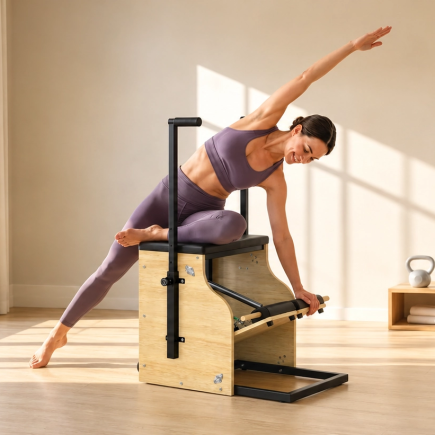











A Pilates chair gives you a full body session without the floor space a reformer demands. It fits a spare room, a basement corner, or a small condo.
The right pick depends on your body, your goals, and your room. This guide helps you choose by checking your goals, build, size, space, resistance, and home setup, whether you plan a gentle Pilates chair workout or a strong full body session.
Key Considerations to Choose a Pilates Chair
1. Match the Chair to Your Fitness Goals
Start with what you want from each session. A clear goal makes every other choice easier, from the number of springs to the height of the handles.
- Beginners need stability and light resistance.
- Advanced users need room to progress.
- Shared use calls for a chair that adjusts to different bodies and levels.
List the exercises you plan to do, such as seated presses, standing leg work, and cord training, then check that the chair supports them. Be honest about your level, since a chair that feels too easy or too demanding is hard to stick with. Adjustable resistance lets one chair handle a gentle Pilates chair workout now and a tougher one later.
If you’re recovering from an injury, check with a health professional first.
Compare Pilates Chair Types
Most chairs fall into three groups. Knowing how they differ helps you avoid features you won’t use and miss none you need.
| Feature | Basic | Adjustable | Multi Feature |
| Adjustable height | Limited | Yes | Yes |
| Resistance options | Basic | More flexible | Multiple |
| Handles | Basic or none | Adjustable | Adjustable |
| Mobility | Usually limited | May include wheels | Often includes wheels |
| Best for | Simple home workouts | Users wanting flexibility | More varied workouts |
This model belongs in the multi-feature group, with adjustable handles, adjustable springs, and wheels.
2. Check Build Quality, Weight Capacity, and Safety
Build quality decides how a chair feels on day one and how it holds up after months of use. You will push, pull, step, and balance on it, so check the frame, the weight limit, and the safety details together.
Build Quality and Frame Materials
A solid frame keeps the chair steady when you press, step, and balance. The pilates chair uses a solid beech wood frame with steel reinforcement and a thick PU padded seat.
- Every joint should sit flush.
- The frame should not flex or creak when you lean on it.
- A thick PU padded seat stays comfortable through a longer pilates chair workout and wipes clean easily.
- Customer reviews that mention wobbling or loose bolts are an early warning sign.
Weight Capacity
Always check the stated limit before you buy. This chair supports up to 264 lbs (120 kg) and weighs 71 lbs itself. Choose a limit that leaves a comfortable margin for every person who will use it.
Safety Features
A chair should feel secure the moment you step on it. This matters even more on hardwood, laminate, and tile floors.
- Non slip feet.
- Secure spring attachments.
- A stable base that stays put during movement.
- Clear assembly instructions.
3. Check Dimensions and Adjustability
Size affects both comfort and fit. Write down the numbers before you compare models, and look at overall width, depth, height, and the adjustable height range.
The seat leaves room to sit tall without crowding your legs. Compare the height range with your ceiling if you plan standing moves, and think about whether everyone using the chair can reach the handles and pedal comfortably.
| Measurement | Pilates Chair |
| Footprint | 31.5 x 31.5 in (80 x 80 cm) |
| Overall height | 37.4 to 47.2 in (95 to 120 cm) |
| Seat size | 21.7 x 13.8 in (55 x 35 cm) |
4. Space for Floor Area, Clearance, and Storage
A chair that fits on paper can still feel tight in a real room. Plan for the chair itself, the room you need to move around it, and the spot where it rests between sessions.
Check the Available Floor Space
- Mark the chair footprint on the floor with painter’s tape.
- Measure from the tape to the nearest wall, bed, or sofa.
- Do this in the room where you will actually train.
Leave Room for Movement
The footprint alone is not enough. Your arms and legs need clearance during a pilates chair workout, especially for standing and stepping moves. Leave a clear path on every side so you can step on and off without bumping furniture.
5. Resistance from Springs, Handles, Cords, and Pedal
Resistance decides how far a chair can grow with you. The spring system, handles, cords, and pedal work together, so check each one before you decide.
Check the Spring System
This model has four 44 lb springs in adjustable positions, so you can use one, two, three, or all four.
- Fewer springs suit a gentle session.
- More springs ask for steadier control.
- Two heavy duty cords with two hook positions each add upper body work.
Change one thing at a time. If you add a spring and move a cord in the same session, it’s hard to tell what made the difference.
Look for Adjustable Handles
Adjustable handles help people of different heights share one chair. Here the handles sit in three positions from 38.6 to 44.1 inches (98 to 112 cm).
- Handles give you a steady point to hold during standing moves.
- Pick a position that lets you hold on without hunching or reaching.
Check the Pedal
The pedal is where much of the action happens, so it should move smoothly and predictably.
- It should feel controlled through its full range.
- There should be no sticking, sudden drops, or resistance spikes.
- A non slip pedal pad keeps your foot steady.
6. Plan Your Home Setup and Maintenance
The best chair is the one that fits your daily routine. Think about the room it will live in and how often you plan to move it.
- An apartment or condo needs a manageable footprint. The built in wheels make this chair easy to tuck away after each session.
- A dedicated home gym gives you room to leave the chair out and train often.
- A bedroom works best when the chair stays clear of the bed frame and dressers, and rolls to a wall when you finish.
- A multipurpose room needs a storage spot picked first, so the chair never blocks daily life.
The chair arrives ready to assemble, so clear a patch of floor for that too. Choose a level, non slip floor.
Care and Maintenance Tips
- Check the springs often. Look for stretching, rust, or uneven tension.
- Tighten the bolts. Check them monthly, as they can loosen over time.
- Wipe it down. Use a soft, damp cloth on the seat and pad after each session. Avoid harsh chemicals.
- Mind the climate. Keep the chair away from heaters, damp basements, and direct sunlight.
7. Pilates Chair Features That Matter Most
Not every feature matters equally to every buyer. Use these priorities as a quick guide.
- If several people share the chair, put adjustable height and handles first.
- If you train often, prioritize the resistance system and a strong frame.
- If your sessions run long, a padded seat makes the biggest difference.
- If your space is small or shared, wheels matter most.
| Feature | Why It Matters | Who Should Prioritize It |
| Adjustable height | Helps accommodate different users | Multiple users |
| Adjustable handles | Allows more flexible positioning | Regular users |
| Resistance system | Provides workout progression | Beginners to advanced users |
| Padded seat | Adds comfort during seated exercises | Longer sessions |
| Wheels | Makes moving the chair easier | Small or shared spaces |
| Strong frame | Improves stability | All users |
Buying Checklist
Before you click “add to cart” run through this list.
✓ Measuring the workout space, ceiling height, and storage spot.
✓ The weight capacity suits everyone who will use it.
✓ The frame is sturdy and the safety features are in place.
✓ The springs, handles, and cords offer enough adjustment.
✓ The pedal action is smooth and controlled.
✓ The seat is padded and the surfaces are non-slip.
✓ The warranty and return policy are clear.
✓ The price fits my budget, including shipping to my province.
Start Your Pilates Routine at Home
The right chair is the one you will actually use. When it matches your goals, fits your space, and leaves room to progress, a few sessions a week become an easy habit.
Aosom Canada ships free to most Canadian addresses, keeps returns open for 30 days, and backs the chair with a one year warranty for added peace of mind. Order the Pilates Chair from Aosom and enjoy your first Pilates chair workout at home this week.
FAQs
Yes, a Pilates chair works when you use it consistently and with good form. The springs add resistance that challenges your core, legs, and arms, while the small seat and pedal demand balance and control. It is not a quick fix, but a few sessions a week can build strength, posture, and stability over time.
The best Pilates chair for home use fits your room, supports your weight, and grows with your routine. Look for a solid frame, adjustable springs and handles, a padded seat, and wheels for easy storage. The Soozier Pilates Chair covers these points with a beech wood frame, four adjustable springs, and a 264 lbs capacity.
Your workout frequency depends on your fitness level, exercise intensity, and recovery needs. Beginners may start with two or three sessions per week, focusing on controlled movements and proper technique. Gradually adjust your schedule as you become more comfortable, and allow adequate recovery between challenging sessions.
Yes, you can use a pilates chair at home without an instructor, provided you understand how to operate the equipment and perform the exercises safely. Beginners should start with clear instructional resources and basic movements before attempting more challenging exercises. If you’re unsure about the correct technique or spring setup, seek guidance from a qualified instructor.
The terms Pilates chair and Wunda chair are often used interchangeably to describe compact Pilates equipment with a seat, pedal, and spring-based resistance system. However, designs and features can vary between manufacturers. Compare each model’s specifications and supported exercises to make sure it suits your workout needs.