











Choosing a kids’ scooter comes down to one number most buying guides ignore, handlebar height. Get that right and the scooter lasts years. Get it wrong and your child cannot ride it properly, whatever the age printed on the box. This guide covers seven models spanning ages 2 to 12, with verified specifications, honest limitations, and what the injury research actually says.
What age can a child start using a kick scooter?
From age 2 on a three-wheel scooter, and around age 5 on two wheels. Three-wheel models steer by leaning rather than turning, which removes the coordination task most preschoolers cannot manage yet.
The Canadian Paediatric Society treats scooter riding as a wheeled sport requiring a certified helmet from the very first ride. Manufacturers of the models below also specify adult supervision, so treat the early years as supervised activity rather than independent play.
How do I know which size scooter fits my child?
Measure your child, not their birthday. Standing on the deck, the top of the handlebar should sit between their navel and the bottom of their ribcage. Too high and they cannot lean into a turn. Too low and they ride hunched.
| Child height | Handlebar range needed | Typical age |
| 80 to 120 cm | 24.8″–29.9″ | 2 to 6 |
| 105 to 125 cm | 28.7″–35″ | 3 to 8 |
| 115 to 140 cm | 31.5″–34.75″ | 5 to 10 |
| 130 to 160 cm | 34.6″–40.6″ | 8 to 12+ |
Why this decides the purchase: A $54.99 scooter topping out at 29.9″ is outgrown around age 6. A $74.99 scooter reaching 40.6″ still fits at 12. Cost per year of use, not sticker price, is the number that matters.
Which kick scooter should I buy?
Seven models cover ages 2 to 12. Weight capacity splits them sharply, three cap at 55 to 110 lb, four support 220 lb.
| Model | Age | Handlebar height | Max load | Price |
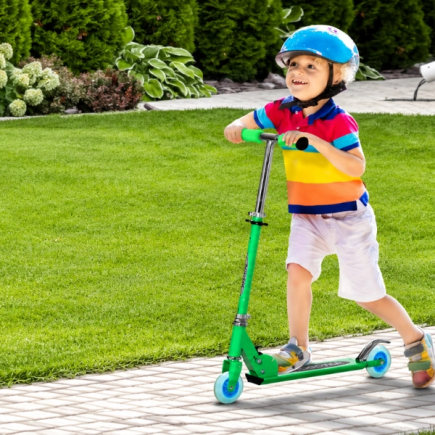
| Qaba 3-Wheel Toddler Scooter | 2 to 6 | 24.8″–29.9″ | 55 lb | $54.99 |
| Qaba Light-Up Folding Scooter | 3 to 8 | 28.7″–35″ | 110 lb | $56.99 |
| Qaba 200mm Big Wheel Scooter | 6 to 12 | 34.6″–40.6″ | 220 lb | $74.99 |
| Qaba Foldable Double-Brake Scooter | 6 to 12 | 34.6″–40.5″ | 220 lb | $87.99 |
| HOMCOM 12″ EVA Big Tire Scooter | 5 to 12 | 31.5″–34.75″ | 110 lb | $99.99 |
| Aosom 12″ Inflatable Dual-Brake | 5+ | 31.5″–33.5″ | 220 lb | $116.99 |
| Aosom 16″ Inflatable Dual-Brake | 5+ | 34.75″–37.75″ | 220 lb | $119.99 |
Note: All prices are in Canadian dollars and correct at time of writing. Prices, availability can change, so confirm against the price box on the product page before ordering.
Which scooter is best for a 2 to 6 year old?
The Qaba 3-Wheel Toddler Scooter, priced at $54.99, the only model here rated below age 3.
| Specification | Value |
| Age / rider height | 2 to 6 years, 80 to 120 cm |
| Handlebar height | 3 levels: 24.8″ / 26.8″ / 29.9″ |
| Wheels | 3 × PU, 4.7″, 3-colour LED |
| Maximum load | 55 lb (25 kg) |
| Braking | Rear fender brake |
| Storage size | 21.3″ × 9.8″ × 7.9″, quick-release |
Pros
- Rated from age 2: The only true toddler option here.
- Fit is verifiable: Published rider height of 80 to 120 cm, not just an age band.
- Packs down small: Quick-release gives you 21″ × 10″ × 8″.
Cons
- 55 lb ceiling: The lowest here. Most children pass 55 lb around age 7, and if yours is already over 40 lb it will not last long.
- Cement only: 4.7″ wheels are the smallest here, and the manufacturer specifies smooth pavement, so cracked or gravel surfaces are out.
Best for: A 2 to 5 year old who has never ridden anything.
Which scooter is best for a 3 to 8 year old?
The Qaba Light-Up Scooter at $56.99, which adds a handbrake most scooters at this price lack.
| Specification | Value |
| Age | 3 to 8 years |
| Handlebar height | 4 levels: 28.7″–35″ |
| Wheels | 2 × magnetic-induction light-up, no batteries |
| Maximum load | 110 lb (50 kg) |
| Bearings | ABEC-7 |
| Braking | Rear fender brake plus handbrake |
| Folding | Yes |
Pros
- Handbrake: Lets a child slow down rather than only stop, the skill that transfers to cycling.
- ABEC-7 bearings: Less effort per push than the ABEC-5 typical at this price.
- 6.3″ of adjustment: Spans roughly five years of growth.
Cons
- 110 lb ceiling: Most children outgrow it on weight before height.
- Wheel size unpublished: And small wheels struggle on frost-heaved pavement, so this is the wrong choice for rough sidewalks or gravel.
Best for: A 4 to 7 year old moving off three wheels.
At $2 more than the three-wheel model, this is the better buy for any child with balance-bike experience.
Which scooter is best for a 6 to 12 year old?
The Qaba 200mm Big Wheel at $74.99 for most buyers, or the Qaba Foldable Double Brake at $87.99 if you live somewhere hilly.
Big wheels matter more in Canada than most markets. Freeze-thaw cycling leaves sidewalks with frequent 10 to 25 mm lips. A 4.7″ wheel stops dead against one. A 200mm wheel rolls over it.
1. Qaba 200mm Big Wheel, $74.99
| Specification | Value |
| Age | 6 to 12 years |
| Handlebar height | 4 levels: 34.6″ / 36.6″ / 38.6″ / 40.6″ |
| Wheels | 2 × 200mm PU |
| Maximum load | 220 lb (100 kg) |
| Suspension | Shock-absorbing front fork |
| Braking | Rear fender brake |
| Folding | Yes |
Pros
- Tallest stem here at 40.6″: The reason it genuinely serves to age 12.
- 220 lb capacity: Double the light-up model, quadruple the three-wheel.
- Front fork suspension: Uncommon at this price, noticeable on textured concrete.
Cons
- One brake only: Fine on flat ground, but not enough if your streets are hilly.
- 34.6″ minimum: Too tall for a 6-year-old under 130 cm, so treat it as an 8 to 12 scooter.
Best for: An 8 to 12 year old on flat suburban sidewalks, where one scooter needs to last several years and still fit in a car.
Qaba Foldable Double Brake, $87.99
| Specification | Value |
| Age | 6 to 12 years |
| Handlebar height | 4 levels: 34.6″–40.5″ |
| Folded size | 33.5″ × 5.9″ × 12.2″ |
| Wheels | 2 × 200mm PU |
| Maximum load | 220 lb (100 kg) |
| Suspension | Dual, front fork and deck |
| Braking | Double brake system |
Pros
- Two brakes: Fixes the one real weakness of the model above.
- Dual suspension: Front fork and deck, not front fork alone.
- Folds to 5.9″ wide: With published folded dimensions you can measure against.
Cons
- $13 premium for overlap: On a flat neighbourhood the 200mm does the same job for $13 less.
- Same 34.6″ minimum: Still too tall for most 6-year-olds.
Best for: An 8 to 12 year old riding hills, where a second brake stops being optional.
Which scooter is best for gravel, dirt or rough ground?
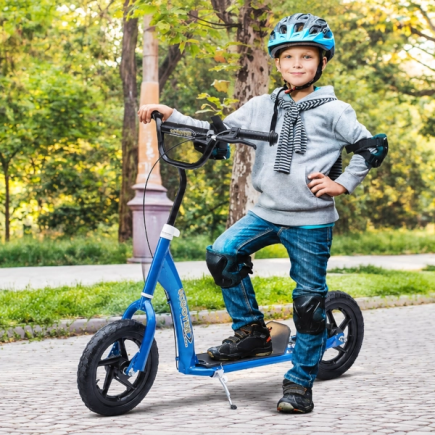
The Aosom 16″ Inflatable at $119.99, with the 12″ version at $116.99 for smaller riders and the HOMCOM EVA at $99.99 if you never want to check tire pressure.
HOMCOM 12″ EVA, $99.99
| Specification | Value |
| Age | 5 to 12 years |
| Handlebar height | 31.5″–34.75″ |
| Wheels | 2 × 12″ EVA foam |
| Maximum load | 110 lb (50 kg) |
| Product weight | 12.1 lb (5.5 kg) |
| Braking | Rear foot brake |
Pros
- Never needs inflating: EVA foam cannot puncture.
- Lowest big-wheel stem at 31.5″: The only one that genuinely fits a 5 or 6 year old.
- Built-in kickstand and non-slip deck: Stands on its own and the wide textured footplate helps kids keep their footing while riding.
Cons
- 110 lb ceiling contradicts the 12-year label: A 12-year-old commonly exceeds it, so this is wrong for a heavier child.
- $25 more than the Qaba 200mm, which has double the capacity and folds, whereas this one does not.
Best for: A 5 to 9 year old of lighter build who wants big wheels without ever checking tire pressure.
Aosom 12″ Inflatable, $116.99
| Specification | Value |
| Age | 5+ years |
| Handlebar height | 31.5″–33.5″ |
| Overall length | 47″ |
| Wheels | 2 × 12″ inflatable rubber |
| Maximum load | 220 lb (100 kg) |
| Braking | Front and rear dual caliper |
Pros
- 220 lb frame in a small-rider fit: The only such combination here.
- Dual caliper brakes: The most complete stopping setup in the range.
- Pneumatic tires absorb impact: The real advantage over EVA foam.
Cons
- Only 2″ of adjustment: The narrowest range here, so a fast-growing child will outgrow it quickly.
- Does not fold, 47″ long: It will not fit a small car trunk.
Best for: A 6 to 9 year old riding gravel driveways, packed trails or textured pavement.
Aosom 16″ Inflatable, $119.99
| Specification | Value |
| Age | 5+ years |
| Handlebar height | 34.75″–37.75″ |
| Overall length | 53.25″–54.75″ |
| Wheels | 2 × 16″ inflatable rubber, alloy hubs |
| Maximum load | 220 lb (100 kg) |
| Frame | Steel, rust-resistant powder coating |
| Variant | Basket and cupholder version, $134.99 |
Pros
- Largest wheels here: 16″ pneumatic handles gravel and broken pavement best in the range.
- Rust-resistant coating: Meaningful in a road-salt climate.
- Basket variant carries a school bag: The only model that works as transport.
Cons
- 53″ to 55″ long and does not fold: Awkward for apartments and small car trunks, so measure first.
- 34.75″ minimum makes “Age 5+” optimistic: This fits an 8-year-old properly.
Best for: An 8 to 12 year old riding gravel or trails.
Can kick scooters be used through a Canadian winter?
They are a three-season purchase for most families.
- Winter storage: Bring inflatable-tire models indoors. Rubber cracks in sustained cold and salt attacks bearings.
- Salt exposure: Only the Aosom 16″ specifies rust-resistant powder coating.
- Spring check: Re-inflate, check stem torque, inspect brake fender wear.
- Winter alternative: The Qaba 2-in-1 Snow Scooter ($54.99) converts between wheels and blades, rated 7+.
How dangerous are kick scooters for children?
Common but usually minor, and a helmet prevents the serious ones.
Most injuries in children’s wheeled sports are broken bones. The dangerous exception is head injury, and that is exactly what a helmet is for. Parachute Canada reports helmets cut head injuries by more than 40%, serious head injuries by 60%, and brain injuries by 53%.
Children also fall differently than adults. Their centre of gravity sits higher, so a sudden stop tips them forward, and their arms are often not strong enough to break the fall.
The Canadian Paediatric Society treats scooter riding the same as cycling and skateboarding, and recommends a certified helmet for all of them.
Safety basics
- Helmet every ride: Look for a CSA, CPSC, Snell or ASTM label inside.
- Pads at the start: Knee and elbow, for the first few weeks.
- Closed-toe shoes: No sandals on a deck.
- Check the stem bolts monthly: Loose clamps are the most common failure.
- Supervise young riders: All of these models specify adult supervision.
Do Kids Need a Helmet on a Kick Scooter in Canada?
Helmet requirements for children riding kick scooters can vary depending on where you live. There is no single federal helmet rule that applies to every kick scooter rider, and provincial or local regulations may have different requirements. Some areas have specific rules for scooters, while others apply helmet requirements mainly to bicycles.
Regardless of the local regulations, wearing a properly fitted helmet is strongly recommended whenever a child rides a kick scooter. It can provide important protection if they fall or collide with an obstacle.
Electric scooters are different from traditional kick scooters and are subject to additional safety and legal requirements in many parts of Canada. These can include minimum age limits, mandatory helmets and restrictions on where they can be ridden. Parents should check the rules in their province and municipality before allowing a child to use an electric scooter.
For younger children, a suitable kick scooter designed for their age and ability is generally a more appropriate choice than an electric scooter. Always follow the manufacturer’s age and weight recommendations and supervise young riders where appropriate.
What are the returns, warranty and shipping terms?
Reflects Aosom’s published terms at time of writing. Confirm on the Returns & Refunds page before purchase.
- Returns: Any reason within 30 days of delivery.
- Return shipping: Free if defective or damaged, otherwise customer-paid.
- Warranty: One year covering material and manufacturing defects.
- Shipping: Free on most scooters in this range.
- Assembly: Required on all seven models.
The one number worth getting right
It comes down to two figures, handlebar range and weight capacity. Match the handlebar to your child’s height today, not the age on the box, and check the weight limit still holds in three years. Whichever you pick, the helmet is not optional.
Measure your child, then find the model that fits. Every scooter in this guide is in stock at Aosom Canada, with free shipping and 30 days to return it.
FAQs
Teach the brake before the pushing, on flat ground. A child who knows they can stop pushes harder and falls less. Keep one pushing foot at first, and expect two or three ten-minute sessions rather than one long one.
A scooter first for most children. Three wheels stay upright on their own, so a nervous toddler succeeds on day one. A balance bike teaches two-wheel balance better, so many families use both, a year or so apart.
No province requires them, but it is dark before 5pm from November to January, exactly the after-school window. LED wheels only show from the side, so add a white front light, a red rear light and reflective tape.
Usually yes, though check your school’s policy first. Many ask that scooters are carried on school grounds, and storage matters if the model does not fold. Keep children under 12 on sidewalks and paths, never roads.