



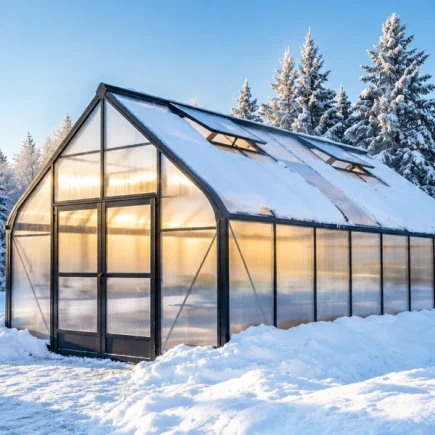










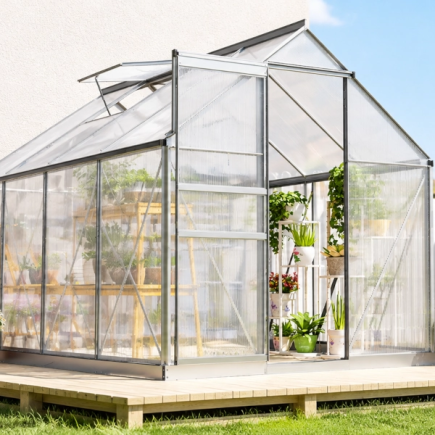







A greenhouse that handles snow well has a steep roof that sheds snow, rigid polycarbonate panels, a strong aluminum or steel frame and a galvanized base that keeps it square. Even the sturdiest home greenhouse still needs snow cleared off the roof, so the best choice is one built to shed snow combined with a habit of brushing it off after every snowfall.
Is Any Home Greenhouse Truly Snow-Proof?
No backyard greenhouse kit is fully snow-proof. Most home models, including many sold for winter use, note that they are not built to carry heavy snow for long periods. Wet snow and ice add weight quickly, and a roof that copes with a light dusting can bend under a deep, packed layer.
That doesn’t mean a greenhouse can’t get through a Canadian winter. It means the right design does most of the work, and you do the rest. A greenhouse that sheds snow easily, sits on a solid base and gets brushed off regularly can stay up through the season.
Six Features That Help a Greenhouse Cope With Snow
When you compare greenhouses for a snowy yard, these are the features that matter most.
1. A Steep, Peaked Roof
Roof shape is the single biggest factor. A peaked roof with steep sides lets snow slide off before it builds up, while a flat or gently curved roof holds snow in place. Look for a clear ridge down the middle and a roof that rises well above the side walls.
2. Rigid Polycarbonate Panels
Polycarbonate panels keep their shape under weight far better than a plastic film cover, which can sag and collect snow in the dips. Twin-wall panels also hold heat better, and a warmer roof helps snow loosen and slide off on sunny days.
3. A Strong Frame
Aluminum and steel frames are the norm for winter greenhouses. Look for a frame described as heavy duty or reinforced, with crossbars along the roof. Closer spacing between roof bars gives each panel more support.
4. A Galvanized Base
A galvanized steel base keeps the frame square and spreads its weight across the ground. Without one, frost movement in the soil can twist the frame, and a twisted frame is weaker when snow piles up.
5. Solid Anchoring
Ground stakes, ground bolts or anchors keep the greenhouse fixed in place as the ground freezes and thaws. Snowstorms often come with strong wind, so firm anchoring protects against both at once.
6. A Manageable Size
Smaller and narrower greenhouses are easier to keep clear. If you can reach most of the roof with a long-handled broom from the outside, you are far more likely to clear it after every snowfall.
Three Aosom Greenhouses Worth a Look for Snowy Yards
The three greenhouses below each bring together several snow-friendly features. None of them lists a snow load rating, so like all home greenhouses, each one still needs its roof cleared after snowfall.
| Greenhouse | Price | Floor Space | Key Snow-Friendly Features |
| WWC 8′ x 6′ Double-Door Polycarbonate Greenhouse | $603.99 | 48.6 sq ft | Sloped roof, galvanized base, 4mm panels |
| WWC 6′ x 12′ Polycarbonate Greenhouse | $665.99 | 76 sq ft | Sloped roof, galvanized base, lower roof that’s easier to reach |
| Outsunny 6′ x 4′ Lean-to Polycarbonate Greenhouse | $294.99 | 26.3 sq ft | Galvanized base, ground stakes, roof easy to reach |
Note: All prices are in Canadian dollars and correct at time of writing. Confirm price and stock before ordering.
1. WWC 8′ x 6′ Double-Door Polycarbonate Greenhouse
| Feature | Details |
| Dimensions | 94.5″ L x 74″ W x 89.5″ H |
| Frame | Heavy-duty aluminum alloy |
| Panels | 4mm polycarbonate |
| Doors | 2 sliding doors |
| Ventilation | Adjustable roof vent |
| Base | Galvanized steel base |
| Temperature range | -20°C to 70°C, according to the product listing |
| Extras | Drainage gutters |
A tall sloped roof and a heavy-duty aluminum frame make this greenhouse a strong starting point for a snowy yard. At 89.5″ high, it has plenty of headroom inside, and its sloped roof is designed to move water away rather than let it sit. Two sliding doors let you get in from either end, which helps when snow has drifted against one side.
Why it suits snowy yards: Its sloped roof helps snow slide off, the galvanized base keeps the frame square on frozen ground, and two sliding doors give you a way in even when snow drifts against one end.
Keep in mind: At 89.5″ tall, the top of the roof is out of reach for most people, so a snow rake with an extendable handle makes clearing much easier.
2. WWC 6′ x 12′ Polycarbonate Greenhouse
| Feature | Details |
| Dimensions | 146″ x 75″ x 77″ H |
| Frame | Heavy-duty aluminum alloy |
| Panels | 4mm polycarbonate, about 70% light transmission |
| Door | 1 sliding door |
| Ventilation | Adjustable roof |
| Base | Galvanized steel base |
| Temperature range | -20°C to 70°C, according to the product listing |
| Extras | Drainage gutters |
Gardeners who want the most growing room will find it in this long greenhouse, with space for beds along both sides and a path down the middle. At 77″ tall, it sits lower than the 8′ x 6′ model, which puts more of the roof within reach when it’s time to clear snow. Its adjustable roof also lets you let out moisture on bright winter days.
Why it suits snowy yards: Its sloped roof helps shed snow and water, the galvanized base keeps the long frame steady, and its lower height makes the roof easier to reach than taller models.
Keep in mind: It’s the longest greenhouse on this list, so there’s more roof to clear after each snowfall, and it needs a long, level spot away from roof edges and trees.
3. Outsunny 6′ x 4′ Lean-to Polycarbonate Greenhouse
| Feature | Details |
| Dimensions | 75.6″ L x 50″ W x 84.3″ H |
| Eave height | 52.8″ |
| Frame | Aluminum alloy |
| Panels | 4mm polycarbonate |
| Door | 1 sliding door, 24.4″ W x 64.6″ H |
| Ventilation | 5-level adjustable window |
| Base | Galvanized steel base with 4 ground stakes |
| Wind rating | Level 4 |
| Extras | Rain gutter |
Small yards and townhouses can still have a winter greenhouse with this compact lean-to model. It sits against a wall, and its single sloped roof is short enough to clear easily from the ground. The wall behind it also blocks wind on one side.
Why it suits snowy yards: The small roof is quick to brush off, the galvanized base with stakes keeps it in place, and the wall behind it keeps wind-driven snow off one side.
Keep in mind: The listing notes it is not designed for heavy snow, so clear the roof after every snowfall. Avoid placing it under a roof edge where snow slides off.
Where to Put a Greenhouse in a Snowy Yard
Placement can add or remove a lot of snow from your greenhouse roof.
- Stay clear of roof edges: Snow and ice sliding off a house, garage or shed roof can land on the greenhouse with real force.
- Avoid overhanging trees: Branches drop heavy clumps of snow and can snap under ice.
- Leave space on all sides: Snow that slides off the greenhouse needs somewhere to go, so it doesn’t pile up against the walls.
- Choose higher ground: Low spots collect drifting snow and meltwater.
- Keep a clear path: A shovelled route to the door means you can reach the greenhouse to clear it after a storm.
How to Prepare Your Greenhouse Before the First Snowfall
A little preparation in the fall helps any greenhouse face its first snowfall in good shape. Work through these tasks before the weather turns.
- Tighten every fixing: Check bolts, screws and panel clips, and replace any that are loose or missing.
- Inspect the panels: Look for cracks or panels that have shifted, and press them firmly back into place.
- Check the anchors: Make sure stakes and ground bolts are secure while the soil is still soft.
- Clean the gutters: Clear out leaves and debris so meltwater can drain away instead of freezing on the roof.
- Seal small gaps: Close up gaps around doors and vents to keep out drifting snow and cold drafts.
- Prune nearby branches: Trim any limbs that hang over or close to the roof.
- Test doors and vents: Make sure they slide, open and latch smoothly before ice can make them stick.
- Keep clearing tools close by: Store a soft broom and a snow rake near the greenhouse so they’re ready after the first storm.
A Simple Snow-Day Routine
A few minutes after each snowfall is the most reliable way to protect any greenhouse.
- Brush early: Clear fresh snow while it’s light and loose, before it packs down or freezes.
- Use a soft broom: A soft-bristle broom or a snow rake with a foam head won’t scratch the panels.
- Work from the top down: Pull snow down and away from the greenhouse rather than pushing it along the roof.
- Leave ice alone: Never chip or hit ice on the panels. Let the sun loosen it, then brush it away.
- Clear around the base: Move snow away from the walls so it doesn’t press against the lower panels.
- Check the frame after big storms: Look for bent bars, loose clips or panels that have shifted.
Matching a Greenhouse to Your Snowy Yard
The right greenhouse is one that sheds snow, stands on a solid base and is small enough for you to keep clear. Choose the WWC 8′ x 6′ Double-Door Polycarbonate Greenhouse for a tall sloped roof in a mid-size footprint, the WWC 8′ x 8′ Raised-Base Polycarbonate Greenhouse for more room on an anchored base, or the Outsunny 6′ x 4′ Lean-to Polycarbonate Greenhouse for a compact model with a roof that’s easy to reach.
Keep your garden growing all winter long. Explore greenhouses at Aosom Canada and pick one that suits your yard, with free shipping on most orders and 30 days to return.
FAQs
Polycarbonate greenhouses on a solid base are usually left up all year if someone can clear the roof. If you’ll be away for long stretches in winter, removing a few roof panels is safer than leaving it unattended.
Yes. Hardy greens and dormant potted plants usually come through a storm fine. Close the doors and vents before the snow starts, then open a vent briefly on the next sunny day to let any trapped moisture escape.
Heat can help snow slide off sooner, but it doesn’t replace brushing. A lightly heated greenhouse won’t clear a heavy layer of snow, and melting snow can refreeze into ice along the edges of the roof overnight.
It depends on your policy. Some home insurance plans cover garden structures and outbuildings, while others don’t. Check with your insurer before winter arrives and ask them specifically about snow and ice damage.
It can be, if the surface is level and strong. A deck must carry the greenhouse, snow, pots and wet soil, so check its strength first. On a concrete patio, bolt the base down with masonry anchors instead of stakes.