










The best greenhouse for cold climates is the Outsunny 6.2′ x 6.3′ x 6.6′ Polycarbonate Greenhouse, priced at $379.99, because it pairs a galvanized base with the strongest stated wind and roof load ratings on this list. Gardeners who want better heat retention can choose the 6′ x 10′ twin-wall model, while the 20′ x 8′ suits large gardens.
Cold-Climate Greenhouse Picks at a Glance
| No. | Greenhouse | Price | Size | Cold-Weather Strength | Best For |
| 1 | 6.2′ x 6.3′ x 6.6′ Polycarbonate Greenhouse | $379.99 | 39.3 sq ft | Level 6 wind rating | Windy, open yards |
| 2 | 6′ x 10′ x 6.4′ Twin-Wall Greenhouse | $499.99 | 59.7 sq ft | Twin-wall panels | Heat retention |
| 3 | 20′ x 8′ x 6.9′ Walk-in Greenhouse | $1,019.99 | 163.6 sq ft | 4 roof vents, galvanized base | Large gardens |
| 4 | 6′ x 8′ x 6.5′ Walk-in Greenhouse | $359.99 | 51.7 sq ft | Bolted galvanized base | Firm anchoring on a budget |
| 5 | 6.6′ x 6′ Wooden Polycarbonate Greenhouse | $659.99 | 40.6 sq ft | 6mm panels, wood frame | Traditional gardens |
Note: All prices are in Canadian dollars and correct at time of writing. Confirm price and stock before ordering. Size is floor area, calculated from each greenhouse’s listed length and width.
What Makes a Greenhouse Good for Cold Climates?
A cold-climate greenhouse needs panels that hold heat, a frame that stays put in wind and a base that keeps it steady on frozen ground. Panel choice makes the biggest difference: in one comparison, 8mm twin-wall polycarbonate had an R-value of 1.64, compared with 0.95 for single-pane glass and 0.83 for single-layer polyethylene.[1]
| Feature | Why It Matters in the Cold |
| Twin-wall or thicker panels | Trapped air between layers slows heat loss on freezing nights. |
| Galvanized base or ground bolts | Keeps the frame square and anchored when wind and frost move the ground. |
| Wind rating | A higher rating means the frame is built to resist stronger gusts. |
| Adjustable roof vents | Releases moisture and excess heat on bright winter days. |
| Bolted or lockable door | Keeps the door shut so cold air and snow stay out. |
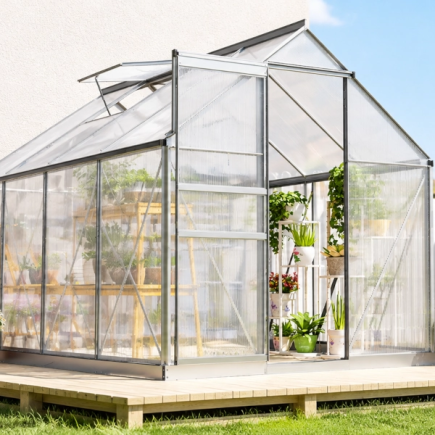
1. Outsunny 6.2′ x 6.3′ Polycarbonate Greenhouse for Windy Sites [2]
| Feature | Details |
| Dimensions | 74.8″ W x 75.6″ D x 79.1″ H |
| Frame | Powder-coated aluminum alloy |
| Panels | 4mm clear polycarbonate |
| Door | 1 sliding door, 23.6″ W x 63.6″ H |
| Ventilation | 1 hinged roof vent and 1 window |
| Base | Galvanized steel base |
| Wind rating | Level 6 |
| Roof load | 8 lbs/ft² |
Strong winds and hard frost are everyday challenges in a cold climate, and the Outsunny 6.2′ x 6.3′ x 6.6′ Polycarbonate Greenhouse is built with that in mind. Its near-square shape suits a sheltered corner of the yard. Seedlings, herbs and potted vegetables all have room on benches around the walls.
Pros
- Highest wind rating on our list, built for open, gusty yards.
- Strongest stated roof load of our five picks.
- Over 140 customer ratings with a 4.7 average.
Cons
- One roof vent, so open the door on sunny winter days for extra airflow.
- Square footprint suits benches and pots rather than long crop rows.
Best for: Windy, open yards that need a sturdy, well-rated greenhouse.
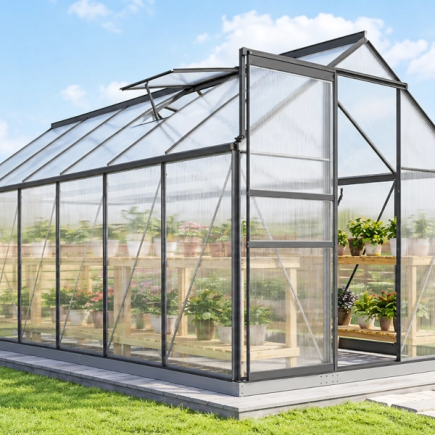
2. Outsunny 6′ x 10′ Twin-Wall Polycarbonate Greenhouse for Heat Retention [3]
| Feature | Details |
| Dimensions | 119.3″ L x 72″ W x 76.8″ H |
| Frame | Powder-coated aluminum alloy |
| Panels | 4mm twin-wall UV-resistant polycarbonate |
| Light transmission | About 90% |
| Door | 1 hinged door with bolt, 24.25″ W x 63.25″ H |
| Ventilation | 1 adjustable roof vent |
| Base | Galvanized steel base |
| Extras | Built-in rain gutters |
Long, bright and well insulated, the Outsunny 6′ x 10′ x 6.4′ Walk-in Greenhouse gives cold-climate gardeners extra weeks at both ends of the season. Its silver frame and clear panels create an open, airy space inside. Raised beds fit along one side, leaving room for shelves and a path on the other.
Pros
- Twin-wall panels hold warmth longer through freezing nights.
- High light transmission helps plants grow on short winter days.
- Bolted hinged door stays shut in strong winds.
Cons
- One roof vent for a 10′ length, so plan to open the door on warm days.
- Panel assembly takes time, so set aside a full weekend.
Best for: Gardeners who want better heat retention and bright growing space.
3. Outsunny 20′ x 8′ Walk-in Greenhouse with 4 Roof Vents [4]
| Feature | Details |
| Dimensions | 244.1″ L x 96.5″ W x 82.7″ H |
| Frame | Powder-coated aluminum alloy |
| Panels | 4mm UV-protected polycarbonate |
| Door | 1 sliding door, 19.7″ W x 68.5″ H |
| Ventilation | 4 adjustable roof vents |
| Base | Reinforced galvanized base |
| Eave height | 4.2′ |
| Extras | Built-in rain gutters |
For gardeners who grow on a big scale, the Outsunny 20′ x 8′ x 6.9′ Walk-in Greenhouse turns a large part of the yard into protected growing space. Its long interior holds full rows of crops, benches for seedlings and a potting area. Families and keen vegetable growers will make use of every foot.
Pros
- Four roof vents release moisture and heat evenly along the full length.
- Galvanized base gives the long frame a solid footing.
- Largest growing space of our five picks.
Cons
- Narrow door, so smaller wheelbarrows and carts fit best.
- Ships in three boxes and takes longer to assemble than smaller models.
Best for: Large gardens and families who grow a lot of their own food.
4. Outsunny 6′ x 8′ Walk-in Greenhouse with Bolted Galvanized Base [5]
| Feature | Details |
| Dimensions | 99.6″ L x 74.8″ W x 78.3″ H |
| Frame | Aluminum alloy |
| Panels | 4mm UV-treated polycarbonate |
| Door | 1 sliding door, 24.4″ W x 64.6″ H |
| Ventilation | 1 roof vent with 5 adjustable opening levels |
| Base | Galvanized steel base |
| Anchoring | 4 ground bolts |
| Wind rating | Level 4 |
Steady footing matters when frost and wind arrive, and the Outsunny 6′ x 8′ x 6.5′ Walk-in Greenhouse is designed to stay planted. Its mid-size layout fits most suburban backyards without crowding the garden. Shelving on both sides leaves a clear walkway for watering and tending plants through the cooler months.
Pros
- Base bolts into the ground for a firm hold through winter.
- Five vent settings let you open just a crack on cold, sunny days.
- Lowest price of our cold-climate picks.
Cons
- One roof vent, so prop the door open on hot summer days.
- Two people and about four hours are needed for assembly.
Best for: Budget-minded gardeners who want a firmly anchored greenhouse.
5. Outsunny 6.6′ x 6′ Wooden Greenhouse with 6mm Polycarbonate Panels [6]
| Feature | Details |
| Dimensions | 79.5″ W x 73.6″ D x 84.3″ H |
| Frame | Fir wood with heavy-duty hardware |
| Panels | 6mm polycarbonate |
| Door | 1 lockable door, 23.2″ W x 67.7″ H |
| Eave height | 59.1″ |
| Interior size | 68.9″ W x 68.5″ D |
Classic wooden framing gives the Outsunny 6.6′ x 6′ Polycarbonate Greenhouse a cottage-style look that suits traditional gardens. Its tall peak leaves plenty of headroom, so working inside feels roomy. It makes a cozy spot for overwintering potted plants, starting seeds early in spring and growing hardy greens through the cooler months.
Pros
- 6mm panels are the thickest of our five picks for better heat retention.
- Wood frame conducts less cold than a metal frame.
- Lockable door keeps tools and plants secure.
Cons
- No roof vent, so open the door on sunny days to release heat and moisture.
- Wood needs a fresh coat of varnish from time to time.
Best for: Traditional gardens and anyone overwintering potted plants.
How Can You Insulate a Greenhouse for Colder Weather?
Insulating the north wall and lower sides is one of the fastest ways to cut heat loss. A double-wall greenhouse wall loses more than 20 times as much heat as an insulated house wall, so adding insulation where sunlight is weakest makes a real difference.[7]
- Insulate the north wall: Fix rigid foam board or foil-faced bubble insulation to the north side, where little winter sun comes in.
- Line the lower walls: Add foam board along the bottom of the walls, behind benches where plants get little light anyway.
- Insulate around the base: Place foam board around the outside of the base to slow the cold rising from frozen ground.
- Use reflective foil: A foil facing bounces light back onto your plants instead of losing it through the wall.
- Remove it in spring: Take down the insulation once the weather warms so the greenhouse can vent freely.
Common Cold-Climate Greenhouse Mistakes to Avoid
The most common mistake is treating a cold-climate greenhouse like a summer one. Small choices in placement and setup decide how well it copes with freezing weather.
- Placing it in a low spot: Cold air settles in dips and hollows, so choose higher, level ground.
- Anchoring after freeze-up: Frozen soil makes stakes and bolts hard to install, so anchor in early fall.
- Letting snow pile against the walls: Snow sliding off the roof can build up and press on side panels.
- Crowding plants against the panels: Leaves touching cold panels can freeze on the coldest nights.
- Choosing a size too large to heat: If you plan to heat in winter, a compact greenhouse costs far less to keep warm.
Which Cold-Climate Greenhouse Should You Choose?
The Outsunny 6.2′ x 6.3′ x 6.6′ Polycarbonate Greenhouse is the best choice for most cold-climate gardeners at $379.99. Choose the 6′ x 10′ for twin-wall heat retention, the 20′ x 8′ for large gardens, the 6′ x 8′ for firm anchoring on a budget, or the 6.6′ x 6′ Wooden model for traditional gardens.
Find a greenhouse built for colder weather with Aosom Canada, with free shipping on most orders and 30 days to return.
FAQs
Yes, but only with heat and good insulation. At -30°C, an unheated greenhouse cannot keep most plants alive, so pair a well-sealed polycarbonate model with a thermostat-controlled heater and insulated north wall.
A wooden frame loses less heat than aluminum, because wood conducts cold more slowly than metal. The difference is small next to panel choice, so twin-wall or thicker polycarbonate matters most for a warm greenhouse.
Both work well. Gravel drains meltwater and helps limit frost heave, while a concrete pad gives the firmest base for bolting down. Whichever you choose, make sure the surface is level before you build the frame.
Polycarbonate stays tough in freezing weather and is far less likely to shatter than glass. Panels are more likely to pop out than crack, so check clips and screws after storms and replace any that have worked loose.
On sunny winter days, an unheated greenhouse can be much warmer than outside. At night, it often drops to only a few degrees above the outdoor temperature, so cold-hardy greens like spinach and kale do best without added heat.
References
[1] University of Arkansas, Greenhouse Management Online. Section 3: Other Glazing Materials.
https://greenhouse.hosted.uark.edu/Unit03/Section03.html
[2] Outsunny 6.2′ x 6.3′ x 6.6′ Clear Polycarbonate Greenhouse, Large Walk-In Green House, Galvanized Sheet Frame with Slide Door, product page.
https://www.aosom.ca/item/outsunny-6-x6-x7-walk-in-greenhouse-polycarbonate-panels-plants-flower-growth-portable-aluminum~845-058.html
[3] Outsunny 6′ x 10′ x 6.4′ Walk-in Garden Greenhouse with Vent, Rain Gutters and Aluminum Frame, Silver, product page.
https://www.aosom.ca/item/outsunny-10-x6-25-x6-4-walk-in-cold-frame-greenhouse-plant-growing-sun-shade-aluminum~845-243V02.html
[4] Outsunny 20′ x 8′ x 6.9′ Walk-in Greenhouse with Adjustable Roof Vent, Rain Gutter and Sliding Door, Clear, product page.
https://www.aosom.ca/item/outsunny-20-x-8-aluminum-polycarbonate-greenhouse-walk-in-garden-greenhouse-kit-with-adjustable-roof-vent-rain~1R09CJTUKB000.html
[5] Outsunny 6′ x 8′ x 6.5′ Walk-in Polycarbonate Greenhouse with Adjustable Roof Vent, Base and Sliding Door, Clear, product page.
https://www.aosom.ca/item/outsunny-6-x-8-x-6-5-walk-in-greenhouse-polycarbonate-greenhouse-with-adjustable-roof-vent-base-sliding-door-clear~1K8OSCRNS3000.html
[6] Outsunny 6.6′ x 6′ Polycarbonate Wooden Greenhouse with Thickened Polycarbonate Sheets and Lockable Door, Brown, product page.
https://www.aosom.ca/item/outsunny-6-6-x-6ft-polycarbonate-greenhouse-wooden-green-house-with-thickened-polycarbonate-sheets-lockable-door-brown~1TLAPLCA47000.html
[7] UMass Extension Greenhouse Crops and Floriculture Program. Insulating Sidewalls and Endwalls Has a Short Payback.
https://www.umass.edu/agriculture-food-environment/greenhouse-floriculture/fact-sheets/insulating-sidewalls-endwalls-has-short-payback