



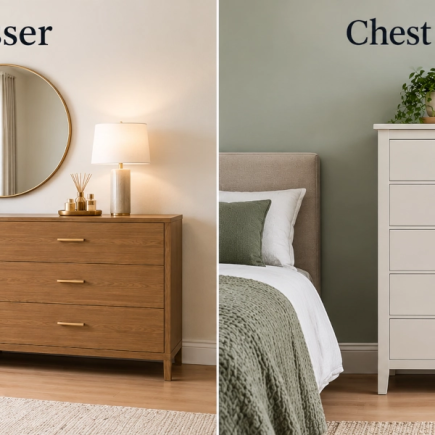
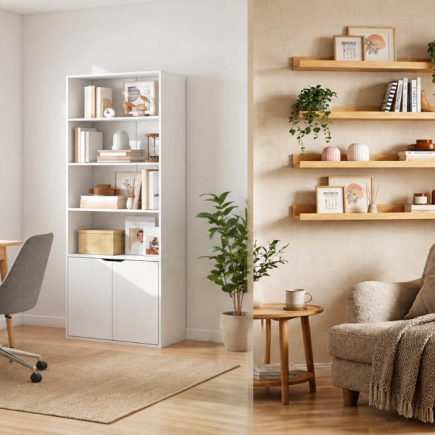





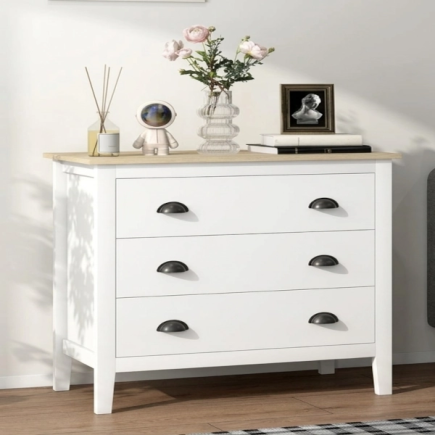













Most Canadians use the words dresser and chest of drawers as if they mean the same thing, but they don’t. A dresser is low and wide with drawers set side by side, while a chest of drawers is tall and narrow with drawers stacked in a single column. That one difference in shape affects how much space each piece takes, what it stores best and which room it suits.
How Do a Dresser and a Chest of Drawers Compare?
Sizes vary by brand, but most pieces sold in Canada fall roughly within these ranges.
| Feature | Dresser | Chest of Drawers |
| Overall shape | Low and wide | Tall and narrow |
| Drawer layout | Two or three columns side by side | One column stacked vertically |
| Height | About 70 to 80 cm (28 to 31 in) | About 80 to 120 cm (31 to 47 in) |
| Width | About 100 to 140 cm (39 to 55 in) | About 55 to 80 cm (22 to 32 in) |
| Depth | About 38 to 45 cm (15 to 18 in) | About 34 to 40 cm (13 to 16 in) |
| Typical drawer count | 6 to 8 | 4 to 5 |
| Top surface | Large and easy to reach | Small and higher up |
| Mirror friendly | Yes | Not really |
| Floor space needed | More | Less |
| Best for | Larger bedrooms and long walls | Small rooms, corners and condos |
What Is a Dresser?
A Dresser is a low, wide storage piece that usually sits around waist height, with drawers set side by side in two or three columns. In many Canadian homes, it is the main storage piece in the primary bedroom, placed on the wall facing the bed.
Features
- Low profile, usually 70 to 80 cm (28 to 31 in) tall.
- Two or three columns of drawers, often six to eight in total.
- Wide drawers, often around 120 cm (47 in) across the full frame.
- Long top surface that can support a mirror.
- Available in single, double and triple widths.
Benefits
- Every drawer sits at a comfortable height.
- Wide, deep drawers fit sweaters, jeans and bedding with ease.
- The top doubles as a getting-ready station or a bedroom TV stand.
- Kids can reach every drawer and put away their own clothes.
Limitations
- Needs a long stretch of open wall that many condos don’t have.
- Takes up more floor space and can crowd a small room.
- Heavy and awkward to move through narrow stairwells and elevators.
What Is a Chest of Drawers?
A Chest of Drawers is a tall, narrow storage piece with drawers stacked in a single column. It makes the most of vertical space, so it fits neatly into condo bedrooms, basement rooms and tight corners where every centimetre counts.
Features
- Taller than it is wide, usually 80 to 120 cm (31 to 47 in) tall.
- Narrow frame, usually 55 to 80 cm (22 to 32 in) wide.
- Four or five drawers stacked in one column.
- Some models split the top row into two small drawers.
- Small top surface for a few decor pieces.
Benefits
- Saves floor space and keeps the area around the bed open.
- Easy to sort items by drawer, like socks, gym gear and pyjamas.
- Works well in hallways, nurseries and home offices too.
- Usually cheaper and easier to move than a large dresser.
Limitations
- On taller models, the top drawer can be a stretch for kids.
- The small, high top is not practical for a mirror or grooming setup.
- Top-heavy by design, so it must be anchored to the wall.
What Are the Key Differences Between a Dresser and a Chest of Drawers?
Both pieces do the same basic job of holding clothes and everyday items, but they go about it in very different ways.
1. Drawer orientation
A dresser spreads its drawers sideways in two or three columns, while a chest stacks them upward in one column.
2. Storage capacity
Wide dresser drawers suit bulky sweaters and bedding. Narrower chest drawers suit folded t-shirts, underwear and accessories.
3. Design and style
Dressers are often the centrepiece of a matching bedroom set with a mirror. Chests usually have simpler designs meant to blend in.
4. Room suitability
A dresser suits primary bedrooms with a long wall. A chest suits condos, guest rooms and small bedrooms.
5. Functionality
A dresser’s waist-high top works as a getting-ready station. A chest’s high top is mostly for display.
6. Cost and safety
Dressers usually cost more because they use more material. Chests are more top-heavy, so anchor either piece to the wall.
What Materials Are Dressers and Chests Made From?
Both pieces come in the same materials, and the material often affects price and lifespan more than the type of piece.
1. Solid wood
Maple, oak, birch and pine are popular choices in Canada. Solid wood is strong, can be refinished and often lasts for generations, though it costs more and can shift slightly with dry winters and humid summers.
2. Plywood and veneer
A wood veneer over a stable core gives a similar look at a lower price and resists warping well.
3. MDF and particleboard
These budget options are fine for a first apartment or guest room, but they don’t handle moisture or repeated moves very well.
4. Metal and mixed materials
Metal frames, cane fronts and rattan details suit modern, industrial or cottage-style rooms.
Whatever you pick, look for dovetail joints, solid drawer bottoms and smooth metal glides.
What Other Names Might You See While Shopping?
Canadian furniture stores mostly list these pieces as dressers, chests of drawers or simply chests, and a few call a tall chest a tallboy. Since labels can vary from store to store, always check the shape and measurements before you buy.
Which Should You Choose?
Choose a dresser if
- You have a long, open wall in a good-sized bedroom.
- You store lots of bulky clothing and bedding.
- You want a mirror and a getting-ready surface.
Choose a chest of drawers if
- Your room is small, narrow or broken up by doors and windows.
- You live in a condo and want to keep floor space open.
- You move often and want a piece that fits more layouts.
If you tick boxes on both lists, a narrow single dresser is a good middle ground.
Can You Use Both in One Room?
Absolutely. In a shared bedroom, a dresser with a mirror for one person and a chest for the other is a popular setup. Matching pieces look tidy together, but a painted chest beside a wood dresser works just as well when the tones complement each other.
What Should You Check Before You Buy?
- Measure the room and the route. Check wall space, doorways, stairwells and your building elevator.
- Leave clearance. Allow 75 to 90 cm (30 to 36 in) in front so drawers open fully.
- Compare drawer interiors. A compact dresser can hold less than a tall chest.
- Test the glides. Drawers should open smoothly and have stops so they don’t fall out.
- Anchor it to the wall. Health Canada has long warned about furniture tip-overs, so install the anti-tip kit and keep heavy items low.
- Check delivery and returns. Many online orders arrive flat-packed, so factor in assembly time.
Sideways or Upward, Which One Fits Your Life?
A dresser stretches sideways with a roomy top, while a chest reaches upward on a compact footprint. Measure your space, think about what you store, and the right pick becomes clear.
Find the perfect fit for your bedroom at Aosom Canada, with stylish dressers and space-saving chests delivered across the country.
FAQs
Yes, as long as its top sits close to your mattress height. A compact chest gives you room for a lamp, phone and glasses, plus far more storage than a standard nightstand, which is a big plus in small condo bedrooms.
Humid Canadian summers can make wood and particleboard swell slightly. Run a dehumidifier, rub a little paraffin wax or bar soap on wooden runners, and check that the piece sits level so drawers glide smoothly again.
Yes, and a chest is usually the easier fit. Measure the closet width and depth first, and leave enough room to pull drawers out fully. Placing it inside the closet frees up bedroom floor space and keeps clothes in one spot.
Keep the items you use daily in the easiest drawers to reach, and store heavy or seasonal pieces like winter sweaters in the bottom ones. Drawer dividers and file-style folding help you see everything at a glance.
Yes, with the right prep. Lightly sand the surface, apply a bonding primer made for slick finishes, then use two thin coats of furniture paint. New handles or legs can also give an older piece a fresh, modern look.