



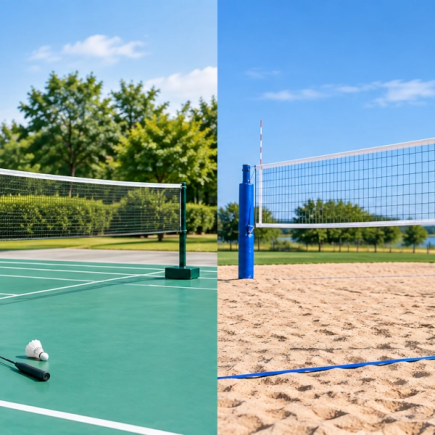




















From school gyms to beach courts, many assume one net works for both games. It doesn’t: each is built for what crosses it, a 5-gram shuttlecock or a hard-hit, 260–280 g volleyball, and that shapes everything from height to strength.
Quick Comparison Table : Badminton Net vs Volleyball Net
| Feature | Badminton Net | Volleyball Net |
| Height at centre | 1.524 m (5 ft) | 2.43 m men / 2.24 m women |
| Height at posts | 1.55 m (5 ft 1 in) | Same as centre (kept level) |
| Net length | At least 6.1 m (20 ft) | 9.5–10 m (31–33 ft) indoor |
| Net depth | 76 cm (2 ft 6 in) | 1 m (3 ft 3 in) |
| Mesh size | 15–20 mm | 10 cm squares |
| Top band | 75 mm white tape, folded | 7 cm canvas band with cable |
| Antennas | No | Yes, two flexible rods |
| Tension | Light, slight sag allowed | High, tight and level |
| Posts | Light tubing, friction/clamp lock | Heavy-gauge, ratchet/crank winch |
| Setup time | ~5–10 minutes | ~15–30 minutes |
| Object crossing net | Shuttlecock, about 5 g | Ball, about 260–280 g |
What Is a Badminton Net?
A badminton net is a low, lightly tensioned net that divides a badminton court, strung between two posts set on the doubles sidelines. It’s built to hold a 5-gram shuttlecock in play rather than absorb heavy impact, which makes it the lightest, lowest net of Canada’s popular court sports.
Benefits of a Badminton Net
A badminton net’s low, light build brings a few practical advantages beyond gameplay.
- Quick setup: Light poles and tape mean it can go up or come down in minutes.
- Portability: Easy to pack for the cottage, park, or a different court each week.
- Clear play: The fine mesh keeps the shuttle visible and in play, cutting down on lost points from snags.
Limitations of a Badminton Net
That same light build comes with trade-offs.
- Low impact tolerance: The fine mesh and tape can stretch or tear if hit repeatedly with a heavier ball or forceful contact.
- Weather sensitivity: Untreated nylon or polyethylene can degrade faster under sun and moisture if left up year-round.
- Limited tension: It’s designed for light tension only, so over-tightening to compensate for sag can strain the posts or tape.
What Is a Volleyball Net?
A volleyball net is a tall, heavily tensioned net that divides a volleyball court in half, strung between two sturdy posts set just outside the sidelines. It’s built to survive a hard-hit, 260–280 g ball rather than just hold shape, so it’s the tallest and strongest net among Canada’s common net sports.
Benefits of a Volleyball Net
A volleyball net’s taller, tensioned build supports serious, competitive play.
- Built for impact: Handles repeated hard spikes and blocks without sagging or stretching.
- Clear boundaries: Antennas and side bands mark legal play width, so calls stay unambiguous.
- Long-term durability: Reinforced bands and cable tensioning hold up to year-round club or league use.
Limitations of a Volleyball Net
The strength that makes it durable also makes it less convenient for casual use.
- Slower setup: Cable tensioning and levelling both sidelines take longer, often needing two people.
- Less portable: Steel cable and reinforced bands add weight compared to a badminton net.
- Higher cost: Regulation-grade tensioning hardware and materials cost more than a badminton net of similar quality.
7 Key Differences Between Badminton Net and Volleyball Net
Each net is engineered around what crosses it, a light shuttlecock or a heavier, hard-hit ball, and that single difference drives every spec below.
1. Net Height
A badminton net sits at 1.524 m centre / 1.55 m at the posts (BWF standard, same for all age and gender categories). A volleyball net sits at 2.43 m for men and 2.24 m for women, pulled level with no sag. That’s an almost 90 cm gap, volleyball is played in the air, so the taller net lets attackers and blockers jump and spike, while badminton’s low net suits drives, drops, and smashes from a shuttle that can exceed 300 km/h.
2. Net Length and Coverage
A badminton net runs at least 6.1 m, matching the doubles court, with posts right on the sidelines. A volleyball net runs 9.5–10 m indoors (~8.5 m for beach), longer than the 9 m court, with posts set 0.5–1 m outside the lines so players don’t collide with them.
3. Net Depth
Badminton nets are 76 cm deep, volleyball nets are 1 m deep. The extra depth on a volleyball net covers more space for digs and reaches near the net, while badminton rallies stay mostly above the tape.
4. Mesh Size
A volleyball is ~21 cm across, so a 10 cm mesh stops it easily and stays light outdoors. A shuttlecock’s feathered skirt is only 6–7 cm wide and could slip through that mesh, which is why badminton nets use a much finer 15–20 mm weave, usually in dark colours to contrast the white shuttle.
5. Top Band, Cables, and Tension
A badminton net has a 75 mm folded tape top band and a light cord, enough to stop a feather-light shuttle. A volleyball net needs a 7 cm canvas band, a steel cable, a tensioned bottom band, and tension straps to stay level under a spiked ball or a blocker’s hands.
6. Antennas and Side Bands
Volleyball nets add 5 cm side bands and two 1.8 m antenna rods marking the legal width of play, the ball must cross between them. Badminton skips this, since its posts already sit on the sidelines.
7. Materials and Durability
Badminton nets use lightweight nylon or polyethylene, which can tear under hard hits. Volleyball nets use thicker braided cord and reinforced stitching to handle spikes. For Canadian outdoor use, choose UV-resistant netting and rust-resistant poles for both.
Can the Nets Be Swapped?
Volleyball net for badminton? No, not for proper play. Even lowered to 1.55 m, the mesh is too large, the net is too long and heavy, and the deep bands make setup bulky. Fine for casual cottage hitting only.
Badminton net for volleyball? No, it’s too short, too shallow, and too light to survive serves and spikes, and will sag or tear even at correct height.
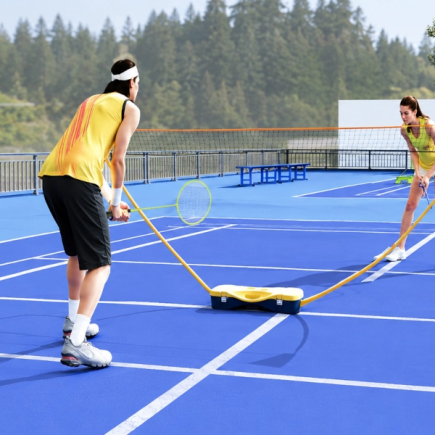
Combo nets: Adjustable badminton-volleyball sets are a practical middle ground for families, affordable and portable, but with a compromise mesh and lighter build unsuited to league play.
Before You Buy, Check
- Space: Measure your court or yard against the dimensions in the comparison table above.
- Climate: For outdoor use, choose UV-resistant netting and rust-resistant poles.
- Players: Adjustable poles help if kids and adults will share the same net.
- Storage: Take outdoor nets down before winter and store them dry to extend their life.
Picking the Net That Fits Your Game
A badminton net is low, light, and finely meshed for a fast shuttlecock. A volleyball net is tall, strong, and built for powerful spikes. Choose a dedicated net for league play, or an adjustable combo set for backyard and cottage fun. Shop Aosom Canada to find the right net for your game.
FAQs
Yes. Sitting volleyball, a Paralympic sport played widely across Canada, uses a net set at just 1.15 m for men and 1.05 m for women, since players stay seated throughout play, noticeably lower than a standard 1.524 m badminton net.
A badminton doubles court is 13.4 m by 6.1 m, plus room to move around it. A volleyball court is much bigger at 18 m by 9 m, with a required 3 m free zone on all sides, so it suits a large yard, park, or gym better than a typical driveway.
Anchor the poles with ground stakes and guy ropes, and tighten tension straps before each game to keep the net taut. On sand or soft ground, drive stakes deeper, and take the net down in strong wind to avoid bent poles or torn mesh.
Measure straight up from the playing surface to the top of the net at the centre. For badminton, also check both posts, since BWF rules allow the centre to sit slightly lower. For volleyball, measure both sidelines to confirm the net stays level.