









Choosing a trampoline is about more than size. Where it goes, who uses it, and how well it handles Canadian weather all matter. This guide walks you through each decision, from type and size to safety features and construction.
What Are the Different Types of Trampolines?
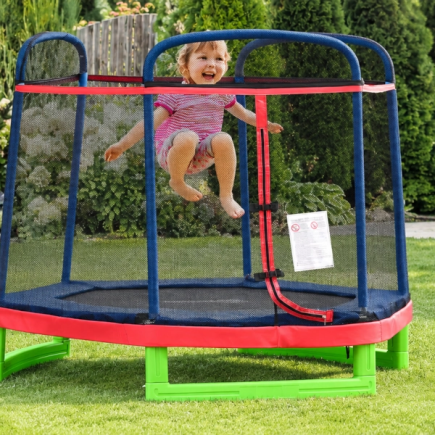
There are three main types of Trampolines, including backyard, in-ground and kids’ trampolines. Each suits a different space and user.
| Type | Best For | Key Features |
| Backyard trampoline | Outdoor family recreation | Sits on steel legs, needs a larger area, usually includes an enclosure |
| In-ground trampoline | A low-profile look | Set level with the lawn, lower fall height, needs digging and drainage |
| Kids’ trampoline | Supervised play for young children | Small, low, fully enclosed, often suitable indoors or outdoors |
Choose the type based on your users and space, not just the size.
What Should You Consider When Buying a Trampoline?
The right trampoline depends on your available space, the people who will use it, and the conditions where it will be installed. Before comparing models, look at five key factors, including size, shape, spring type, weight capacity and safety features.
How Do You Choose the Right Trampoline Size?
Measure your available space before selecting a trampoline.
The manufacturer’s stated diameter does not represent the entire area you need. You also need the recommended clearance around the trampoline and sufficient overhead space.
Check:
- The total available ground area.
- The trampoline’s assembled dimensions.
- Required clearance around the equipment.
- Overhead obstructions such as branches or structures.
- Ground condition and levelness.
Example: The Soozier 10ft Outdoor Trampoline with Enclosure Net and Ladder measures 120.1 inches (about 10 feet) across and 98.4 inches (about 8.2 feet) high with its enclosure. With about 2 metres (6.5 feet) of clear space on every side, you would need a flat area of roughly 23 x 23 feet. You should also keep around 7 metres (24 feet) of open space overhead, free from branches, roof edges and power lines.
Do not select a larger model simply because it provides more jumping space. The trampoline must fit safely within the available installation area.
Which Trampoline Shape Should You Choose?
Shape can affect how the jumping surface is used.
Round Trampolines are commonly used for general recreational jumping and are suitable for many household settings.
Rectangular trampolines provide a different jumping pattern and may be preferred for certain training activities where a longer jumping surface is useful.
The available space should also influence the decision. Compare the manufacturer’s dimensions rather than choosing based only on the nominal size.
Should You Choose a Spring or Springless Trampoline?
Choose a spring trampoline if you want a lively bounce at a lower price, and a springless trampoline if you want to remove exposed springs and hard edges.
Spring trampolines use steel coil springs to connect the mat to the frame. Look for long, galvanized springs that are fully covered by thick padding.
Springless trampolines use flexible rods or leaf springs placed away from the jumping area. There are no coils to catch fingers or toes, but they usually cost more.
How Do You Choose the Right Weight Capacity?
Weight capacity should be checked against the intended user’s body weight before purchase.
The manufacturer’s maximum weight limit is a product specification, not a target. Users should remain within that limit, and any restrictions regarding multiple users should also be followed.
When comparing models, check whether the stated capacity applies to:
- One user.
- Multiple users.
- A particular activity.
- A specific model configuration.
For households with different users, base the decision on the manufacturer’s requirements for the people who will actually use the trampoline.
Which Safety Features Matter Most?
Safety features should be assessed as a complete system rather than individually, and the right features depend on the type of trampoline.
For a backyard trampoline, check whether the product includes:
- A suitable enclosure system.
- A secure entrance.
- Protection over exposed frame components.
- Securely attached enclosure poles.
- A stable support structure.
- A jumping mat designed for the intended use.
For an in-ground trampoline, check whether the product includes:
- Padding that covers the springs and frame edge at ground level.
- A retaining wall or kit that keeps soil away from the springs.
- Ventilation or drainage beneath the jumping mat.
- A clear, level surface around the pit.
For a kids’ trampoline, check whether the product includes:
- A fully enclosed net with a secure zippered entrance.
- Thick foam padding on every pole.
- A low frame height for safe access.
- A clearly stated recommended age and weight limit.
Also check the manufacturer’s safety instructions, age recommendations and applicable product standards. Canada has no trampoline-specific regulations, so the Canada Safety Council recommends choosing a trampoline that meets ASTM requirements.
Safety features should not be evaluated separately from installation. Even a trampoline with appropriate protective equipment needs to be installed and used according to its instructions.
How Can You Assess Trampoline Build Quality?
Instead of judging quality from appearance, examine the main structural components.
1. Frame
Check the material, tube construction and manufacturer’s specifications. A frame should be designed to support the stated load and intended use.
2. Jumping Mat
Look at the material, attachment system and outdoor-use specifications. For an outdoor model, check whether the material is designed to withstand the expected environmental exposure.
3. Springs or Springless System
The jumping system should match the product’s intended use and stated capacity. Most backyard trampolines use steel coil springs, while springless and some kids’ models use flexible rods or elastic cords instead.
4. Enclosure
Check how the enclosure connects to the frame and whether the entrance and attachment points are secure.
5. Legs and Base
The support system should provide appropriate stability for the size and design of the trampoline.
Rather than choosing based on one component, compare the complete construction against the manufacturer’s specifications.
How Should You Choose a Trampoline for Canadian Weather?
For an outdoor trampoline, consider the conditions it will experience throughout the year.
Sunlight can affect materials over time, while rain and humidity can contribute to the deterioration of unsuitable materials. Wind can affect stability, and snow and freezing temperatures create additional seasonal maintenance requirements.
For outdoor use, check whether the product specifications mention:
- Corrosion-resistant or galvanized frame components.
- UV-resistant materials.
- Weather-suitable jumping surfaces.
- Outdoor-rated enclosure materials.
- Recommended seasonal storage or protection.
These specifications do not mean the trampoline requires no maintenance. Follow the manufacturer’s instructions for cleaning, inspection, covering, storage and weather protection.
How Should You Maintain a Trampoline During Winter?
Winter care depends on the product and local conditions.
Before winter, review the manufacturer’s instructions and determine whether the trampoline should remain assembled, be partially dismantled, or be stored.
If the trampoline remains outdoors, check it regularly for:
- Snow accumulation.
- Ice.
- Moisture.
- Frame corrosion.
- Damage to the jumping surface.
- Loose or damaged components.
Do not use the trampoline when the jumping surface is covered with snow or ice unless the manufacturer specifically states otherwise.
How Do You Choose a Trampoline for Different Users?
Each age group needs something different. Use this quick guide to match the trampoline to the main users.
| User | What to Look For |
| Young children | A small, low kids’ trampoline with a full enclosure and padded poles. Always follow the recommended age and supervise closely. |
| Older children | A round backyard trampoline of 8 to 12 feet with an enclosure, which keeps jumpers near the centre. |
| Teenagers | A larger trampoline of 12 feet or more with a higher weight limit and a sturdy frame. |
| Adults | A large backyard trampoline with a user weight limit well above your body weight. |
| Young gymnasts | A rectangular trampoline, which gives a stronger, more even bounce for practising skills. |
Always check the manufacturer’s age and weight limits before you buy.
What Should You Check Before Buying a Trampoline?
Before you buy, make sure the trampoline:
- Fits your yard with enough clearance around and above it.
- Has a weight limit above the heaviest user.
- Includes the right safety features for its type.
- Uses galvanized steel and UV-resistant materials.
- Meets ASTM safety requirements.
So, Which Trampoline Should You Choose?
The right trampoline is the one that fits your space, suits the people who will use it, and can handle the conditions where it will be kept. Start by choosing the right type, then compare size, shape, weight capacity, safety features and construction using the same criteria for every model. For outdoor use in Canada, give extra weight to weather-resistant materials and the manufacturer’s winter care guidance.
Ready to compare your options? Browse the full range of trampolines at Aosom Canada.
FAQs
Yes, if it is safe to do so. Clear all snow and ice first, as frost makes the mat slippery. Cold weather can also stiffen the mat and net, so check for cracks before jumping and wear grippy socks instead of winter boots.
Replace the mat if it sags, fades, or shows fraying stitches. Replace springs if they are rusty, stretched, or no longer spring back into shape. Check both at the start of each season, especially after a long Canadian winter.
Many Canadian home insurers see trampolines as a higher risk, and some may raise premiums, add conditions, or limit coverage. Call your insurer before you buy to check whether trampoline injuries on your property are covered.
Yes, as long as the turf is level and the ground beneath it is firm. Place rubber pads under the legs to protect the turf, and check that the anchor stakes can pass through the turf and hold securely in the soil below.
No. Shoes can damage the mat and increase the risk of injury to other jumpers. Bare feet or non-slip trampoline socks give better grip and protect the mat. Remove jewellery and empty pockets before jumping as well.