













Yes, a cover can protect plants from a light frost and from many insects. It is not a fit-and-forget fix, though. The same cover can overheat plants on a sunny day and keep pollinators out once crops flower.
- Frost: Guidance treats a cover as a light-frost tool, adding up to about 10°F (5°C) of warmth, not protection from a hard freeze.[1][2]
- Pests: A fabric or net cover keeps insects off when it is properly secured and goes on before pests arrive.[3][4]
- Overheating: Covers trap heat. Ontario guidance says to vent or remove them above 32 to 35°C (90 to 95°F).[5]
- Pollination: Insect-pollinated crops need the cover opened or removed at flowering.[1][5]
- Choice: Pick the cover for the job. Heavier fabric or plastic suits frost, and fine netting suits insects. A built-in cover helps if it opens easily.
How Much Frost Can a Raised Bed Cover Handle?
A cover handles light frost. The figures below come from four different pages, and each describes a different cover, so they are not directly comparable.
| Source | Cover | Stated protection |
| University of Saskatchewan | Frost cloth | Minor frosts, “one to two degrees of frost” (unit not stated)[4] |
| Utah State University | Medium and heavyweight row cover fabric | 28°F (about -2°C) for medium, 24 to 28°F (about -4 to -2°C) for heavyweight[3] |
| University of Wisconsin | Floating row covers | Plants stay 5 to 10°F (3 to 6°C) warmer, with protection to 28°F[2] |
| Colorado State University | Floating row covers; plastic on a frame | Up to 10°F (about 5°C); 3 to over 6°F (2 to 3°C or more)[1] |
Utah State gives the lowest temperature a cover handles, and the others give degrees gained. Even the highest figure is about 10°F of added protection. Read that as shelter for a light frost on seedlings, not a guarantee on a hard-freeze night.
Colorado State separates frost from a cold front and frost on a calm, clear night. Check your forecast too. Colorado State gives no dates for Canadian regions, so look up your local last and first frost dates.[1]
Which Cover Does Which Job?
The right cover depends on whether the worry is cold or insects. Light matters too, because heavier fabric lets less of it through.
| Cover | Best for | Watch for |
| Lightweight row cover fabric | Insects. Lets through about 90% of light.[3] | No frost figure is given. Wind can tear it.[3] |
| Medium to heavyweight fabric | Frost. Lets through about 85% down to 30 to 50% of light.[3] | Less light for the plants as it gets heavier. |
| Insect netting | Insects, when the sides are secured.[4] | Captures less heat, so it suits cool-season crops.[4] |
| Plastic cover on a frame | Frost, with about 3 to over 6°F (2 to 3°C or more) in Colorado State’s trials.[1] | Heat builds fast. Solid plastic can also block pollinating insects and precipitation.[6] |
Hoops can be attached to a raised bed, or plastic stapled to the sides of a wooden bed box.[2][1]
Do Covers Really Keep Pests Out?
Yes, many insects, if the mesh is fine enough, the edges are secured and the cover goes on early. Utah State lists aphids, flea beetles and root maggot flies among the pests they exclude.[3] Three things decide whether they work.
- Mesh size: Choose a mesh fine enough that the target pest cannot get through.[3]
- Secured edges: Insect netting works as a barrier when properly secured, so weigh the edges down or bury them a few inches.[4][1]
- Timing: Lay the cover over plants before pests are evident in the area.[3]
A cover cannot remove pests already inside. Utah State advises checking seedlings for insects before transplanting, and rotating crops by plant family so that a cover does not go over plants where eggs may have been laid the previous year.[3]
Alberta describes finer weaves as keeping out some pests, not all.[6]
Can a Cover Overheat Plants?
Yes, heat is a risk with any cover. Most overheating figures come from cold frames, tunnels and row covers, not from bed kits. Temperatures under one can run 5 to 15°F (about 3 to 8°C) higher than outside.[3]
- Speed: Colorado State says a closed plastic-covered cold frame can pass 130°F (54°C) after an hour of sun.[1]
- Plants: Tomatoes and peppers abort flowers to some degree when daytime temperatures top 90°F (32°C).[3]
- Threshold: Ontario guidance says to remove or ventilate row covers above 32 to 35°C (90 to 95°F).[5]
- Spring: Alberta notes that high spring daytime temperatures can make tunnel temperatures excessively high and affect flowers and plant survival.[6]
South Dakota State advises ventilating on warm sunny days, and closing again in the late afternoon. Cool-season crops do best at air temperatures between 50 and 80°F (10 to 27°C), and a thermometer helps you decide when to vent.[7]
When Should the Cover Come Off?
Take it off when frost danger has passed, or when crops need insects to pollinate them.
- Flowering: Colorado State says covers must be removed on insect-pollinated crops for pollination to occur. Ontario guidance says row covers on bee-pollinated vine crops must be removed or opened at flowering.[1][5]
- Squash and cucumbers: Utah State says to remove the cover once these plants begin to flower. It gives the same advice for tomatoes and peppers.[3]
- Warm weather: Tunnels come off when warm weather arrives and the danger of frost is past.[1]
What Routine Keeps a Cover Working?
Check the forecast, vent on warm days, water, check the edges, and open the cover at flowering on insect-pollinated crops.
- Check the forecast. On freezing nights, close the cover fully, and do it in the late afternoon.[1][7]
- On warm, sunny days, open or vent it, and keep a thermometer inside.[7]
- Water under the cover. Lift row covers to water if you have no drip line.[3]
- Check the edges and anchors after wind, because wind can lift or tear covers.[3]
- Remove or open the cover at flowering on insect-pollinated crops, or when frost danger is over.[1][5]
Is a Built-In Cover Better Than Hoops and Fabric?
Neither is better overall. A built-in cover is quicker to set up, and hoops and fabric are easier to swap by season. This comparison is general reasoning, not a tested result.
| Feature | Built-in cover | Hoops and fabric |
| Setup | Comes with the bed, so there are no hoops to source. | Add hoops and a cover you choose. |
| Flexibility | One cover type for frost, heat and pests. | Swap fabric, net or plastic by season. |
| Watch for | Check it has vents or a roll-up side, and whether it comes off. | Anchor the edges against wind. |
For a first-time grower, a cover that vents or rolls up is easier to manage than a sealed one.
Ask three questions before you buy a bed with a cover. Does it open for venting? Does it come off for pollination? Is the cover type right for frost or insects?
What Does the Evidence Cover?
The sources are five US and Canadian university extension pages and two provincial government pages. They cover row covers, frames, tunnels and cold frames in general.
The pages reviewed do not test a cover sold as part of a raised bed, and they give no Canadian frost dates. Figures differ because the covers and conditions differ. The Alberta page was last reviewed in 2017.
Worked Example With Two Aosom Covered Beds
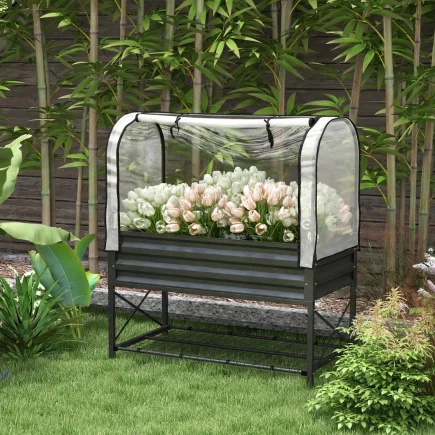
Two beds from the Aosom Raised Garden Beds Range show the checks in use: the Outsunny 6′ x 3′ Metal Planter Box With Cover and Mini Greenhouse[8] and the Outsunny 5.7 x 3 x 2.3 ft Steel Planter Box With Net Cover[9].
| Feature | Mini Greenhouse Planter Box[8] | Net Cover Planter Box[9] |
| Cover | Polyethylene (PE), 2 roll-up windows | Net cover, vents not stated |
| Overall size | 72.8 x 37.4 x 36.2 in (185 x 95 x 92 cm) | 68.5 x 35.4 x 27.6 in (174 x 90 x 70 cm) |
| Planting area | 70.1 x 35 x 11.6 in (178 x 89 x 29.5 cm) | 66.1 x 33.5 x 11.8 in (168 x 85 x 30 cm) |
- The job: The listing describes the PE cover as protecting plants from excessive heat or cold, and as keeping out rabbits and squirrels. The net cover is described as keeping out birds and animals.
- Frost and insects: Neither listing gives frost figures or an insect mesh size, so check both before relying on either for frost or insects.
- Venting: The mini greenhouse has two roll-up windows for venting. Use a thermometer rather than assuming the cover manages heat.
- Pollination: The listings do not say whether the cover comes off fully, so plan how you would reach the flowers.
- Price and delivery: Priced at $98.99 (Mini Greenhouse Planter Box) and $98.99 (Net Cover Planter Box) at time of writing, with free shipping to most of Canada. Contact us within 30 calendar days of delivery to return it.
What Mistakes Do Gardeners Make With Covers?
- Leaving it closed in the sun: Heat can build fast under plastic.
- Gaps at the edges: Insects get in and wind can lift the cover.
- Covering too late: Pests already present are covered in with the plants.
- Forgetting flowers: Pollinators cannot reach flowers under a closed cover.
- Heavy fabric on seedlings: Heavier fabric lets in less light.
- Trusting one figure: Protection depends on the cover and the night.
A Few Things Worth Remembering
A raised bed cover protects against a light frost and keeps many insects away, if it is sealed and put on early. A closed plastic frame can also overheat within an hour of sun.
Choose fabric or plastic for frost and fine netting for insects. Secure the edges, and put the cover on before pests arrive. Vent on warm, sunny days, and open the cover at flowering on insect-pollinated crops.
For a built-in cover, check that it vents and comes off. Keep a thermometer inside, and check your local frost dates before you plant out seedlings.
FAQs
Yes. Raised garden bed covers with a net or PE cover keep birds from pecking seedlings and stop rabbits and squirrels reaching low leaves, as long as the cover sits close to the bed and has no gaps at the edges.
A solid plastic or PE cover does. Raised garden bed covers made from plastic block rain and precipitation,[6] so you will need to water underneath or lift the cover after rain. A fabric or fine net cover lets rain through, and Utah State advises lifting row covers to water if you have no drip line.[3]
You can leave raised garden bed covers on in winter to shelter empty soil and hardy crops, but do not leave a sealed plastic cover on through warm spells. Colorado State says tunnels come off when warm weather arrives and the danger of frost is past,[1] and South Dakota State advises ventilating on warm sunny days.[7]
Yes. Raised garden beds warm the soil and hold moisture in, which helps seeds germinate earlier in spring. Colorado State and Wisconsin both treat covers as a way to extend the season and protect early growth,[1][2] but keep the cover vented once seedlings appear, or heat and damp can cause weak, leggy growth.
Yes, if they are anchored. Raised garden bed covers catch wind like a sail, so a loose cover will lift or tear. Utah State notes wind can lift or tear covers, so check edges and anchors after wind.[3] On a balcony, a low, close-fitting cover is safer than a tall tunnel.
References
[1] Frost Protection and Extending the Growing Season – Colorado State University Extension.
https://extension.colostate.edu/resource/frost-protection-and-extending-the-growing-season/
[2] Extending the Garden Season – University of Wisconsin-Madison Extension, Wisconsin Horticulture.
https://hort.extension.wisc.edu/articles/extending-garden-season/
[3] Row Covers – Utah State University Extension.
https://extension.usu.edu/pests/research/row-covers
[4] Row coverings in no till gardening – Gardening at USask, University of Saskatchewan.
https://gardening.usask.ca/articles-and-lists/articles-notillgardening/rowcovers.php
[5] Season extension techniques for vegetable crops – Ontario.ca
https://ontario.ca/page/season-extension-techniques-vegetable-crops
[6] Microclimate Modification with Plasticulture – Government of Alberta, Agriculture and Forestry.
https://www1.agric.gov.ab.ca/$department/deptdocs.nsf/all/faq8266
[7] Cold Frames – South Dakota State University Extension.
https://extension.sdstate.edu/cold-frames
[8] Outsunny 6′ x 3′ Metal Planter Box with Cover, Raised Garden Bed with Mini Greenhouse for Herbs, Vegetables, Green and Dark Grey | Aosom Canada.
https://www.aosom.ca/item/outsunny-6-x-3-metal-planter-box-with-cover-raised-garden-bed-with-mini-greenhouse-for-herbs-vegetables-green-and-dark~22FULABLK6000.html
[9] Outsunny Raised Garden Bed, 5.7 x 3 x 2.3ft Steel Planter Box Outdoor with Cover, Gloves, Dark Grey | Aosom Canada.
https://www.aosom.ca/item/outsunny-raised-garden-bed-5-7-x-3-x-2-3ft-steel-planter-box-outdoor-with-cover-gloves-dark-grey~23N48BN341001.html