



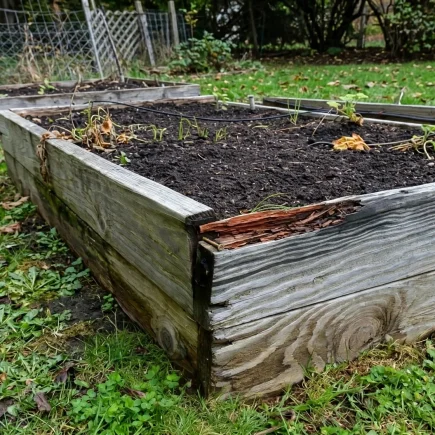
















Replace a wooden raised bed when its boards, corners or base crumble or feel spongy, because a 1969 Canadian Building Digest on wood in buildings says decayed wood is usually difficult to repair.[1] Then measure the old bed, choose a non-biodegradable replacement such as galvanized steel,[2] empty the old bed, prepare the site and rebuild.
- Step 1, decide: Widespread spongy or crumbling boards point to replacing the bed, since decayed wood can still look firm.[1]
- Step 2, choose: Measure the old bed, then pick a non-biodegradable material. University of Maryland Extension lists galvanized steel under that heading.[2]
- Step 3, empty: Reuse the soil, but test it for heavy metals first if the old bed used older treated lumber.[3]
- Step 4, prepare: Pick sunny, level ground with good drainage, and take a soil sample from the cleared spot first.[2]
- Step 5, rebuild: Refill with the saved soil and top up with fresh mix, because an Ask Extension answer says most garden mixes hold only about one season of nutrients.[4]
Why Do Wooden Raised Beds Rot After a Few Seasons?
Wooden beds rot because soil keeps the lower boards damp, and the wood type sets how fast.
- Moisture: A 1969 Canadian Building Digest on wood in buildings says about 35 to 50 per cent moisture is needed for rot fungi to flourish.[1]
- Soil contact: The digest says infection can spread from soil to wood in contact with it, and Washington State University Extension lists direct wood-to-ground contact as a moisture source.[1][5]
- Wood type: Utah State University Extension says untreated fir rots and breaks down within a few years.[6]
- Any material: Maryland lists degrading materials as a general drawback of raised beds, so any enclosure needs maintenance and replacing if it starts to fall apart.[2]
A new bed of the same untreated wood would sit in the same conditions.
Step 1. Decide Whether to Repair or Replace the Bed
Replace the bed when decay is widespread, because rot can hide behind a firm surface.
- What decay looks like: Soft, spongy, stringy or crumbly, though the wood may still look hard and firm.[1]
- When it shows: WSU says significant weakening has occurred by the time damage can be seen.[5]
- Repair odds: The digest says decayed wood is usually difficult or even impossible to repair. It writes about building parts, so treat that as a guide, not a rule.[1]
| What you see | Likely move |
| Crumbling or spongy corners and bottom boards | Replace the bed. Decay is usually hard to repair.[1] |
| Soft spots in one or two boards | Replace those boards if you can, and inspect the rest closely. |
| Warped boards on a cheap bed | Warping is not rot, so look for soft spots before you decide. |
| Only fading or surface wear | Reseal it. Maryland suggests exterior latex paint or a semi-transparent oil-based stain for untreated wood.[2] |
The right-hand column is this article’s reasoning, apart from the cited points. For the reseal route, see the Aosom guide to sealing a wood raised bed.
Step 2. Measure the Old Bed and Choose a Replacement That Will Not Rot
Measure the old bed’s inside length, width and height, then choose a material that will not rot. Buy before you take the old bed apart, so the soil is out of the bed for as short a time as possible.
Start with the material options.
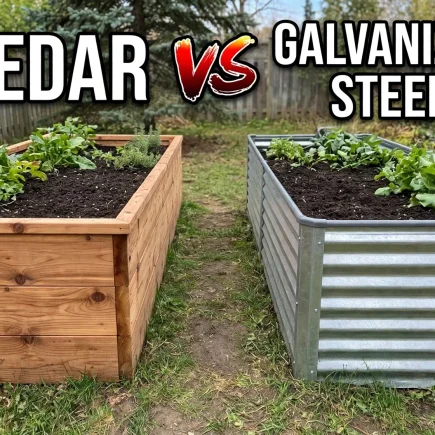
- Cedar or redwood: Utah State calls them naturally rot resistant,[6] and Oregon State University Extension calls them more expensive but long-lasting and safe.[7]
- Durable heartwood: The Canadian Wood Council, an industry body, says naturally durable heartwood can serve more than 10 years above ground in temperate climates, but untreated heartwood is not recommended for long-term ground contact.[8]
- Galvanized steel: Maryland lists it (rust-resistant) under non-biodegradable materials and says decay-resistant materials generally last longer.[2]
None of the sources reviewed gives a bed lifespan in years for either material. Use these checks when you compare beds.
- Material: Choose a non-biodegradable material and read the listing for the finish.
- Footprint: Match your old bed’s measurements, or pick a size that fits the spot.
- Depth: Maryland gives at least 8 inches for leafy greens, beans and cucumbers, and 12 to 24 inches for peppers, tomatoes and squash, for beds on hard surfaces.[2]
- Width: Beds are usually 2 to 4 feet across.[2]
- Coating and thickness: Look for both on the listing. The two pages below name a powder-coated finish, but neither states steel thickness or zinc coating weight.
Two Aosom Canada galvanized steel beds show how these checks work for different footprints.
| Feature | Galvanized Planter Box[9] | 8′ x 4′ x 1′ Raised Garden Bed[10] |
| Footprint | 6 x 3 ft | 8 x 4 ft |
| Inner depth | 22.6 inches | 30 cm (about 12 inches) |
| Bottom | Open | Open |
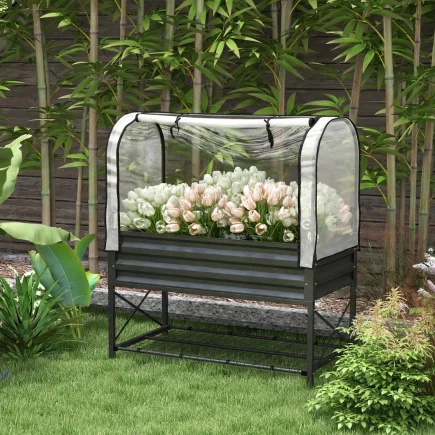
Suits a 6 ft Bed and Deeper-Rooted Crops: Outsunny 6′ x 3′ x 2′ Galvanized Raised Garden Bed[9]
This bed suits a 6 ft by 3 ft footprint and crops that need depth.
- Why it fits: It has an open bottom and is described as having a powder-coated finish with enhanced rust resistance.
- Depth: At 22.6 inches inside it falls within Maryland’s 12 to 24 inch range for peppers and tomatoes on hard surfaces.[2]
- Good to know: It is rated 5.0 from 2 ratings, so the evidence is thin. Tools needed are not listed.
- Price and delivery: Priced at $89.99 (Outsunny 6′ x 3′ x 2′ Galvanized Raised Garden Bed) at time of writing, with free shipping to most of Canada. Contact us within 30 calendar days of delivery to return it.
Suits a Large 4 x 8 ft Footprint: Outsunny 8′ x 4′ x 1′ Galvanized Raised Garden Bed With Open Bottom[10]
This bed suits a 4 x 8 ft footprint and shallower crops, at 1 ft deep.
- Why it fits: It has an open bottom and is described as excelling in rust and weather resistance.
- Depth: At 30 cm (about 12 inches) it is close to Maryland’s 12-inch low end for tomatoes on hard surfaces, and above its 8-inch figure for leafy greens.[2]
- Good to know: It has no ratings yet. Gloves are advised during assembly.
- Price and delivery: Priced at $88.99 (Outsunny 8′ x 4′ x 1′ Galvanized Raised Garden Bed) at time of writing, with free shipping to most of Canada. Contact us within 30 calendar days of delivery to return it.
Step 3. Empty the Old Bed and Check the Soil
Once the new bed is on its way, take the old one apart.
- Plants and soil: Lift out the plants, shovel the soil onto a tarp and cover it until the new bed arrives.
Then sort the soil by what the old bed was made of.
- Garden mix only: An Ask Extension answer says most mixes have only enough nutrients for one season, so plan to refresh it.[4]
- Compost: The same answer warns that regular, heavy compost can build up phosphorus and soluble salts.[4]
- Older treated lumber: Maryland says CCA was discontinued for outdoor residential structures in 2004.[2] Clemson advises a heavy-metal soil test, and says that if heavy metals are present you should stop growing vegetables in the bed or replace the soil mix.[3]
- Old boards: Do not burn treated wood or use its ash or compost on edible gardens.[11] These sources are American, so also check local Canadian rules.
Step 4. Clear and Level the Site
With the old bed and its soil out of the way, prepare the spot.
- Light and drainage: Maryland says the best location for a raised bed is sunny, level ground with good drainage.[2] A spot that stays wet is worth reconsidering, since moisture drives decay.[1]
- Soil sample first: Maryland says that when a bed goes on existing soil, the first step is a sample sent to a laboratory before any changes.[2]
- Then level: Rake out splinters and wood chips and level the ground.
- Weedy ground: On lawn or weeds, Maryland suggests plain cardboard (non-waxed, tape removed) to kill the vegetation underneath.[2]
Step 5. Build the New Bed and Refill It
Now the new bed, the cleared spot and the saved soil come together.
- Assemble: Build on the level ground, adding cardboard first if the spot is weedy. The 6′ x 3′ x 2′ page does not list the tools needed, and the 8′ x 4′ x 1′ page asks for gloves.
- Reuse the soil: Put the saved soil back first.
- Top up: Add fresh mix to restore nutrients, and keep compost moderate. For poor or compacted soil, Maryland suggests a 1:1 mix of compost and soilless growing media.[2]
For a full walkthrough, see the Aosom guide to filling a raised garden bed.
Who Should Replace the Bed and Who Should Look Elsewhere?
Replacing suits gardeners whose boards are failing across the bed. Two other routes may fit better.
- Replace the bed: Boards, corners or base are crumbling or spongy.
- Reseal instead: Only surface wear or fading.
- Stay with wood: Check the species and any treatment on the listing.
Recommendation
Replace the bed when most of its boards crumble or feel spongy, and do not repeat the same untreated wood. Choose a non-biodegradable material, then test the soil and prepare a level, well-drained spot.
The two Aosom Canada beds above cost $89.99 and $88.99 at time of writing. The 6′ x 3′ x 2′ bed suits a 6 ft footprint and deeper-rooted crops, and the 8′ x 4′ x 1′ bed suits a large 4 x 8 ft footprint.
If you choose galvanized steel, read the zinc answer above and test your soil pH first. If you stay with wood, pick a rot-resistant species.
FAQs
Often yes. An Ask Extension answer says most garden mixes hold only about one season of nutrients, so refresh the soil before replanting. If the old bed used older treated lumber, test for heavy metals first, as Clemson advises, and replace the soil if they are present.[4][3]
Extension answers differ, so test your soil pH first. A Nevada Extension educator’s column says zinc is fairly stable unless acid or heat reaches it, and that pH 6.5 to 7.5 is optimal for garden soil. One Ask Extension answer says there is no definitive research, and an older one calls zinc the biggest concern.[12][13][14]
Avoid it around food if the lumber is older treated wood. The National Pesticide Information Center says not to burn treated wood or use its ash or compost on edible gardens. An Ask Extension answer also advises avoiding older CCA, creosote and penta treatments.[11][15]
A bed holds its inner length times width times depth. The listings give 885 L for the 6′ x 3′ x 2′ bed and 219 US gallons (about 829 L) for the 8′ x 4′ x 1′ bed. Measure your emptied old bed the same way to see how much extra soil you need.
References
[1] Decay of Wood, Canadian Building Digest 111 – Division of Building Research (M.C. Baker, March 1969).
https://web.mit.edu/parmstr/Public/NRCan/CanBldgDigests/cbd111_e.html
[2] Growing Vegetables in Raised Beds – University of Maryland Extension.
https://extension.umd.edu/resource/growing-vegetables-raised-beds
[3] Treated Wood in the Landscape – Clemson Cooperative Extension, Home and Garden Information Center (August 2017).
https://hgic.clemson.edu/factsheet/treated-wood-in-the-landscape/
[4] Ask Extension answer on soil in a raised bed (asked and answered 22 March 2026).
https://ask.extension.org/kb/faq.php?id=926507
[5] Wood-rotting fungi – Washington State University Extension.
https://pestsense.cahnrs.wsu.edu/fact-sheet/wood-rotting-fungi/
[6] Raised Bed Gardening – Utah State University Extension.
https://extension.usu.edu/yardandgarden/research/raised-bed-gardening
[7] Raised bed gardening, FS 270 – Oregon State University Extension Service.
https://extension.oregonstate.edu/pub/fs-270
[8] Durability Research and Development – Canadian Wood Council.
https://cwc.ca/why-build-with-wood/durability/durability-research-and-development
[9] Outsunny 6′ x 3′ x 2′ Raised Garden Bed, Galvanized Planter Box for Growing Flowers, Herbs and Vegetables, Light Grey | Aosom Canada.
https://www.aosom.ca/item/outsunny-6-x-3-x-2-raised-garden-bed-galvanized-planter-box-for-growing-flowers-herbs-and-vegetables-light-grey~22TF9TGAC8G01.html
[10] Outsunny 8 x 4 x 1ft Galvanized Raised Garden Bed, Reinforced Outdoor Planter Box with Open Bottom, Green | Aosom Canada.
https://www.aosom.ca/item/outsunny-8-x-4-x-1ft-galvanized-raised-garden-bed-reinforced-outdoor-planter-box-with-open-bottom-green~241C302MK0G01.html
[11] Treated Wood Fact Sheet – National Pesticide Information Center, Oregon State University (reviewed February 2019).
https://npic.orst.edu/factsheets/treatedwood.html
[12] Is corrugated metal safe for vegetable gardens? JoAnne Skelly, University of Nevada Cooperative Extension, Carson Now, 26 April 2020.
https://www.carsonnow.org/04/26/2020/joanne-skelly-column-corrugated-metal-safe-vegetable-gardens
[13] Galvanized Steel for Raised Vegetable Garden…is it safe? – Ask Extension (answer to a question asked in 2016).
https://ask2.extension.org/kb/faq.php?id=324102
[14] galvanized steel garden beds – Ask Extension (answer to a question asked in 2014).
https://ask2.extension.org/kb/faq.php?id=180091
[15] Ask Extension answer on 25-year-old treated lumber (asked March 2025).
https://ask.extension.org/kb/faq.php?id=895028