



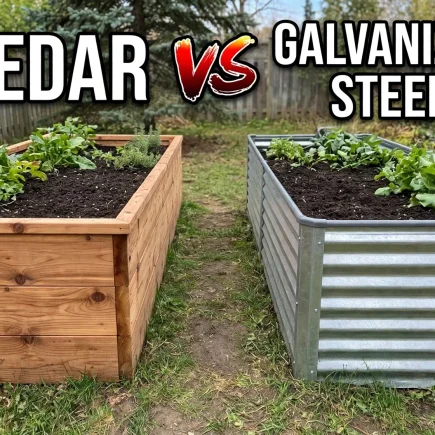








Choose cedar if you want a clearer food-safety record and will accept wood upkeep. Choose galvanized steel if you want a non-biodegradable material, since Maryland says decay-resistant materials generally last longer, and will check the finish and your soil pH.[1] Neither has been compared in Canadian winters in the sources reviewed.
- Rot: Cedar and redwood lumber is naturally rot resistant, while untreated fir rots and breaks down within a few years.[2]
- Rust: Galvanized steel is listed as rust resistant, and the sources reviewed give no lifespan in years.[1]
- Lifespan: Naturally durable heartwood can give service lives of more than 10 years above ground in temperate climates.[3]
- Heat: One extension column says galvanized metal reflects heat. No page measured soil temperature in metal beds.[4]
- Food safety: Cedar is called a long-lasting, safe choice.[5] Extension answers differ on zinc from galvanized steel.[4][6][7]
How Do Cedar and Galvanized Steel Beds Compare?
This table sets the two materials side by side on the worries gardeners raise most.
| Factor | Cedar | Galvanized steel |
| Rot | Heartwood is naturally rot resistant.[2] | Not applicable to steel. Rust is the failure to watch. |
| Rust | Not applicable to wood. | Described as rust resistant.[1][4] |
| Lifespan evidence | Durable heartwood: over 10 years above ground. Not recommended long term in ground contact.[3] | The sources reviewed give no figure. |
| Summer heat | Raised beds in general heat up and cool down more quickly.[5] | One column says galvanized metal reflects heat.[4] |
| Food safety | Called a safe choice.[5] | Answers differ. Zinc is a concern if acid or heat reach it.[6][4] |
| Upkeep | Any bed material is maintained and replaced periodically. Paint, stain or a liner are options for wood.[1] | Listed among non-biodegradable materials. Decay-resistant materials generally last longer.[1] |
Will a Cedar Raised Bed Rot?
Cedar resists rot better than untreated fir does, but it does not last forever.
- Species matters: Utah State says cedar and redwood are naturally rot resistant. It says untreated fir rots and breaks down within a few years.[2]
- Heartwood: Canadian Wood Council field tests found naturally durable heartwoods can last more than 10 years above ground in temperate climates.[3]
- Soil contact: The same page says untreated durable heartwood is not recommended for long-term performance in ground contact. Western redcedar and yellow cypress were the most durable in its ground-contact tests.[3]
A bed wall sits against damp soil, which is closer to ground contact than above-ground use. Do not read 10 years as the expected life of a bed, because the sources reviewed give none.
Will Galvanized Steel Rust?
Galvanized steel is described as rust resistant, but no lifespan in years is given.
Maryland Extension lists galvanized steel among rust-resistant materials.[1] A Nevada extension educator says zinc-coated corrugated metal resists rusting.[4]
These sources describe galvanized steel in general, not any one bed. A listing that names the steel thickness, coating and finish gives you something to compare. One that doesn’t leave those details unknown.
Does a Galvanized Bed Get Too Hot in Summer?
Neither source measured soil temperature in metal beds. The Nevada column says galvanized containers reflect heat, so overheating roots should not be a problem.[4]
Oregon State says raised beds in general heat up and cool down more quickly than in-ground beds.[5] A soil thermometer will show what your own bed does.
Is Each Material Safe for Growing Food?
Untreated cedar has the clearer record. Oregon State calls cedar or redwood a long-lasting, safe choice, and says to choose a material that will not leach chemicals into the soil.[5]
Galvanized steel is less settled.
- No definitive research: An Ask Extension answer says so, and adds that zinc is likely to stay in place unless acid or heat corrodes it.[6]
- Acid soil: The Nevada column says any zinc entering soil at an optimal garden pH of 6.5 to 7.5 would be in very small quantities, and that cadmium can release if soil is acidic.[4]
- A cautious view: An older Ask Extension answer calls zinc the biggest concern. It expects zinc levels to take several years to become an issue, and prefers treated wood or composite.[7]
What About Canadian Weather?
The sources reviewed do not compare the two materials in Canadian winters, so this is a gap, not a finding.
- Cedar: The Canadian Wood Council’s durability figures are for temperate climates and above-ground use.[3]
- Steel: No page reviewed covers freeze-thaw or snow load on galvanized panels.
- Both: Oregon State says raised beds heat up and cool down faster than in-ground beds, which matters in a short growing season.[5]
Which Material Fits Your Priority?
This table matches common priorities to the evidence above. The Better fit column is the article’s reasoning from those sources.
| If your priority is | Better fit | Why |
| A natural look and a clear food-safety record | Cedar | Called a long-lasting, safe choice.[5] |
| Less upkeep | Galvanized steel, with limits | Decay-resistant materials generally last longer, but any bed material is maintained and replaced periodically.[1] |
| Acidic or unknown soil | Cedar, or test pH first | Zinc is more of a concern with acid.[4] |
| A lower upfront cost | Untreated softwood such as SPF, with a shorter life | Maryland says untreated SPF is less expensive than pressure-treated wood, and Utah State says untreated fir rots within a few years.[1][2] |
How Do You Choose Between Them?
Use these five checks before you buy.
- Check the wood species and part of the tree. Cedar heartwood and untreated fir are different materials.[2]
- Test your soil pH. If it is acidic, zinc is more of a concern.[4]
- Decide on upkeep. Any bed material is maintained and replaced periodically, and wood can be painted, stained or lined.[1]
- Read the finish and coating on a metal bed’s listing.
- Compare the warranty and return terms on each listing.
What Does the Evidence Cover?
The sources are Utah State, Oregon State, Maryland and Nevada extension material, two Ask Extension answers asked in 2014 and 2016, and the Canadian Wood Council, an industry body.
None compares cedar and galvanized beds in Canadian winters, and no Canadian government page was found. The Utah State page dates from 2012.
Worked Example With One Galvanized Bed
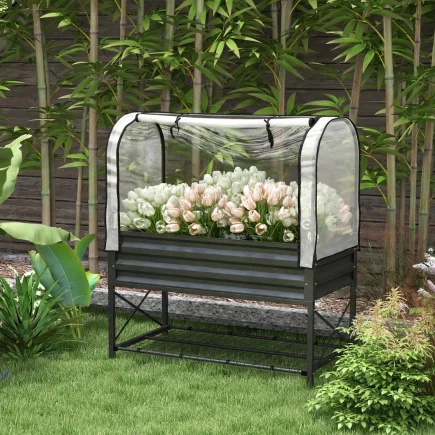
The Aosom Raised Garden Beds Range shows how the checks apply. The Outsunny 6′ x 3′ x 2′ Galvanized Raised Garden Bed[8] is one example.
- Material: The listing says galvanized steel with a powder-coated finish, and that the finish enhances rust resistance.
- Not stated: No steel thickness or zinc coating is given, so the listing cannot settle the rust question alone.
- Bottom: It has an open bottom, so the soil sits against the steel and the ground.
- Warranty: One year on material and manufacturing defects.
- Price and delivery: Priced at $109.99 (Outsunny 6′ x 3′ x 2′ Galvanized Raised Garden Bed)[8] at time of writing, with free shipping to most of Canada. Contact us within 30 calendar days of delivery to return it.
What Mistakes Do Gardeners Make When Choosing a Bed Material?
- Assuming wood is cedar: Fir and other untreated softwoods are different, and untreated fir rots within a few years.
- Trusting one lifespan number: The sources reviewed give none for galvanized steel.
- Skipping the soil test: Acid soil changes the zinc question.
- Ignoring the finish: A coating is only as good as the listing says.
- Using old treated wood or railroad ties: Oregon State and Utah State both flag creosote.[5][2]
Our Recommendation
Cedar suits gardeners who want a natural look, the clearer food-safety record and who accept wood upkeep. Galvanized steel suits those who want a non-biodegradable material and will check the finish and soil pH.
On heat, one extension column says galvanized metal reflects heat, but no page measured soil temperature. On zinc, extension answers differ, so test your soil pH. Confirm the wood species or metal finish on the listing, and compare price and warranty before you choose.
FAQs
A galvanized steel raised garden bed does not need drainage holes if it has an open bottom, because water drains straight into the ground below. The example bed here has an open bottom for drainage.[8] If you put a galvanized steel raised garden bed on concrete or a patio, you need drainage holes or a gap underneath, or water will pool and speed up rust at the base.
For a galvanized steel raised garden bed, heat is less of a worry than many expect. One extension column says galvanized metal reflects heat,[4] and Oregon State says raised beds in general heat up and cool down more quickly than in-ground beds.[5] In a hot Canadian summer, still check soil with a thermometer and mulch the surface for lettuce, spinach and other cool-season crops.
Yes. You can put a cedar raised garden bed straight on grass, but lay cardboard or newspaper under the soil first to smother the grass. Cedar heartwood is naturally rot resistant,[2] but constant contact with damp grass and soil is closer to ground contact, where untreated durable heartwood is not recommended for long-term performance.[3]
References
[1] Growing Vegetables in Raised Beds – University of Maryland Extension.
https://extension.umd.edu/resource/growing-vegetables-raised-beds
[2] Raised Bed Gardening – Utah State University Extension.
https://extension.usu.edu/yardandgarden/research/raised-bed-gardening
[3] Durability Research and Development – Canadian Wood Council.
https://cwc.ca/why-build-with-wood/durability/durability-research-and-development
[4] Is corrugated metal safe for vegetable gardens? JoAnne Skelly, University of Nevada Cooperative Extension, Carson Now, 26 April 2020.
https://www.carsonnow.org/04/26/2020/joanne-skelly-column-corrugated-metal-safe-vegetable-gardens
[5] Raised bed gardening, FS 270 – Oregon State University Extension Service.
https://extension.oregonstate.edu/pub/fs-270
[6] Galvanized Steel for Raised Vegetable Garden…is it safe? – Ask Extension (answer to a question asked in 2016).
https://ask2.extension.org/kb/faq.php?id=324102
[7] galvanized steel garden beds – Ask Extension (answer to a question asked in 2014).
https://ask2.extension.org/kb/faq.php?id=180091
[8] Outsunny 6′ x 3′ x 2′ Raised Garden Bed, Galvanized Planter Box for Growing Flowers, Herbs and Vegetables, Light Grey | Aosom Canada.
https://www.aosom.ca/item/outsunny-6-x-3-x-2-raised-garden-bed-galvanized-planter-box-for-growing-flowers-herbs-and-vegetables-light-grey~22TF9TGAC8G01.html