








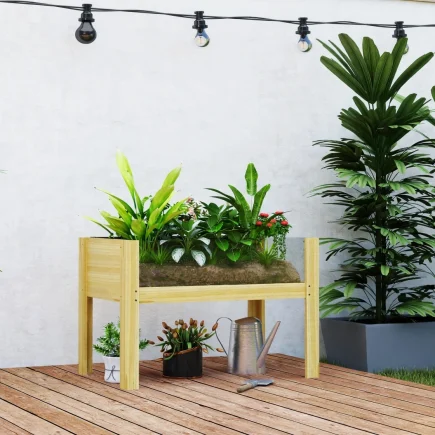






A low-maintenance raised garden bed cuts the watering you do by hand and has a frame that resists rot. A reservoir still needs refilling, so pair the bed with mulch and, for longer trips, a drip timer.
- Watering: Raised beds dry out faster than in-ground beds, so spread 2 to 4 inches of straw mulch and consider drip irrigation on a timer.[1][2][3]
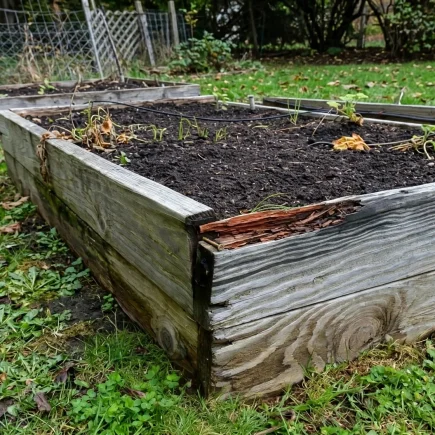
- Frame: Untreated fir rots within a few years, so look for steel or plastic and read the listing for its finish.[3]
- Suits weekend travel: The Outsunny 2-Piece Self-Watering PP Raised Bed has a self-watering disk and a 4.8 rating from 68 ratings.[4]
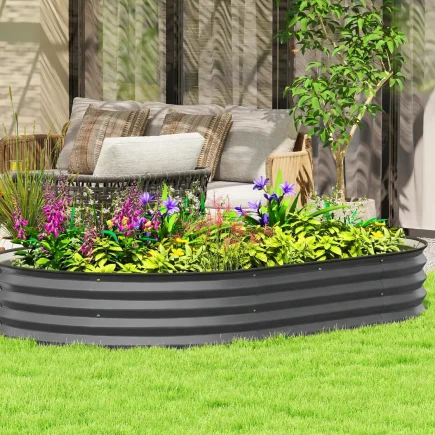
- May suit low upkeep: The Outsunny 6′ x 1.5′ x 1.3′ Galvanized Raised Bed is listed as built to last for years without much care.[5]
Why Does a Raised Bed Turn Into a Chore?
A raised bed turns into a chore when it dries out between visits or when the frame fails early. Both can be planned for before you buy.
Kansas State says raised beds tend to dry out more quickly in summer and need more water than conventional plantings.[1] Utah State adds that warmer raised soil loses more water to evaporation.[3]
The frame matters just as much. Utah State says untreated lumber such as fir will rot and break down within a few years.[3]
How Do You Choose a Low-Maintenance Raised Garden Bed?
Work through four steps, starting with watering because it takes the most time.
Step 1: Plan how the bed will be watered
Start with the water, because a bed you can leave for a weekend is easier to keep. Three options cut the work, and you can combine them.
- Mulch: North Carolina Extension says mulch helps soil retain moisture and reduces how often you need to water.[2] Kansas State suggests a 2 to 4 inch (5 to 10 cm) layer of straw after the soil has warmed.[1]
- Drip irrigation: Utah State says drip or trickle irrigation is the most efficient for raised beds, and mentions drip tubing controlled by a timer.[3] Washington State’s container guidance says a drip system with an automatic timer works while you are away.[6]
- Self-watering design: Washington State describes self-watering pots as having a water reservoir.[6] A University of Kentucky wicking tub with a 3.4 gallon reservoir may need refilling every 3 to 5 days under moderate to heavy plant loads, and every week to 10 days under light loads.[7]
That Kentucky tub is a do-it-yourself design, not an Aosom bed. It still suggests that a reservoir stretches watering by days, so a short trip may be manageable, while a long holiday suits a timer or a fuller plan. Washington State says a trip of 10 days or longer needs a more comprehensive plan.[6]
With watering sorted, move on to the frame, because that decides how long the bed lasts.
Step 2: Choose a frame that will not rot
Wood can fail early when it is not rot resistant. Utah State says cedar and redwood are naturally rot resistant, while untreated fir breaks down within a few years.[3] Wooden beds vary, so check the species and finish on the page.
Steel and plastic frames avoid the wood-rot problem, but each listing needs checking.
- Galvanized steel: Read the listing for the finish, coating and any rust wording, and for the steel thickness if it is given.
- Plastic (PP): Check the listing for care wording and the weight each box can hold.
Once the frame is chosen, check how much soil the bed holds.
Step 3: Match the depth and plan for weeds
Depth decides which plants will grow well. Kansas State recommends at least 6 to 8 inches, where most feeder roots take up nutrients and water.[1] Some listings give overall height, not planting depth, so find the inner depth on the page.
Weeds are the other upkeep job. Kansas State says straw mulch also helps control weeds.[1] Check each listing for any weed wording, and treat it as the maker’s claim.
Last, look at what the bed asks of you to set up and look after.
Step 4: Check assembly and care wording
A low-maintenance bed should be quick to put together and should not need regular repairs. Read the page for the tools needed, any care advice and the warranty. Aosom lists a one-year warranty covering material and manufacturing defects.
Which Beds Suit Weekend Travellers and Busy Households?
Two Aosom Canada beds fit the steps above in different ways. One helps with watering and the other with the frame.
| Bed | Suits | Watering help | Frame | Planting depth | Rating | Price |
| 2-Piece Self-Watering PP Raised Bed | Weekend travel | Self-watering disk | PP plastic | 7 in | 4.8 from 68 | $62.99 |
| 6′ x 1.5′ x 1.3′ Galvanized Raised Bed | Low upkeep | None listed | Galvanized steel | 15.75 in (listed) | 4.8 from 5 | $79.99 |
Suits Weekend Travellers: Outsunny 2-Piece Self-Watering PP Raised Bed[4]
This set has a self-watering disk, which may cut how often you water. The listing does not say how much water it holds. It is a plastic bed, so wood rot is not the concern.
- Why it fits: The listing says excess water is reserved with a self-watering disk and drainage holes. It has a 4.8 rating from 68 ratings, more than the other bed.
- Good to know: Planting depth is 7 inches, which meets Kansas State’s 6 to 8 inch minimum, so check each crop’s root depth.[1] No reservoir size or care wording is listed.
- Setup: The listing says it goes together without tools or screws, and lists 66 lb per bed.
- Price and delivery: Priced at $62.99 (2-Piece Self-Watering PP Raised Bed) at time of writing, with free shipping to most of Canada. Contact us within 30 calendar days of delivery to return it.
May Suit Low Upkeep: Outsunny 6′ x 1.5′ x 1.3′ Galvanized Raised Bed[5]
This is a steel bed for gardeners who mainly want a frame that lasts. It sits on the ground with an open bottom and lists no watering feature, so pair it with mulch or drip irrigation.
- Why it fits: The listing says it is built to last for years without much care and maintenance, with an anti-rust coating. It also says the bed keeps weeds out of the soil. Read these as the maker’s wording, not tested results, and an open bottom may still let weeds in from below.
- Good to know: The listed interior height is 15.75 inches, though the page also shows 44 cm, so confirm before ordering. No steel thickness or weight capacity is listed, and the 4.8 rating rests on only 5 ratings.
- Setup: Gloves are included, but the listing does not say which tools you need.
- Price and delivery: Priced at $79.99 (6′ x 1.5′ x 1.3′ Galvanized Raised Bed) at time of writing, with free shipping to most of Canada. Contact us within 30 calendar days of delivery to return it.
Who Should Look at Other Options?
Neither bed fits every garden. Look elsewhere in these cases.
- Large crops: Crops with deep roots may need more depth than a 7 inch bed. See the guide on how deep a raised garden bed should be.
- Long trips: If you are away for 10 days or more, Washington State’s container guidance points to a drip system with an automatic timer.[6]
- A wooden look: Check the wood species and finish on the page, and see how to seal and protect a wood raised bed.
What Do the Reviews and Evidence Show?
The self-watering set has 68 ratings averaging 4.8, and the galvanized bed has 5 ratings averaging 4.8. Five ratings is a small base, so the evidence for the steel bed is thin.
Kansas State, Utah State and North Carolina Extension describe raised beds. Washington State covers watering containers, and Kentucky tested a do-it-yourself wicking tub. None tested these two beds, and none covers how steel or plastic frames last through Canadian winters, so the lifespan of either bed is not stated here.
What About Safety, Delivery and Returns?
Check these points before you buy.
- Weight: The plastic set lists 66 lb per bed. The galvanized page lists no weight capacity.
- Delivery: Shipping is free to most of Canada, except YT, NT, NU and some rural postal codes.
- Returns and warranty: Return within 30 days of delivery, with no fee if the item is defective or damaged. Aosom lists a one-year warranty covering material and manufacturing defects. Otherwise the customer pays return shipping.
Key Takeaways
For weekend travel, start with the self-watering set, and choose the galvanized bed if the frame matters most.
- Watering: Add 2 to 4 inches of straw mulch and consider a drip timer, because raised beds dry out faster.[1][3]
- Frame: Untreated fir rots within a few years, so read the finish and coating on any bed you buy.[3]
- Suits weekend travel: Outsunny 2-Piece Self-Watering PP Raised Bed, with a self-watering disk and 68 ratings at time of writing.[4]
- May suit low upkeep: Outsunny 6′ x 1.5′ x 1.3′ Galvanized Raised Bed, listed as built to last for years without much care.[5]
FAQs
Water when the soil dries slightly, and plan on one or more inches per week, as Kansas State recommends. Raised beds tend to dry out faster in summer, so check the soil by hand rather than following a fixed schedule.[1]
Usually not. A reservoir still needs refilling. A University of Kentucky wicking tub may need it every 3 to 5 days under moderate to heavy plant loads, and about every week to 10 days under light loads. Check the reservoir size on any bed you buy.[7]
References
[1] Raised Bed Gardening (MF2134) – Kansas State University Research and Extension, revised May 2022.
https://bookstore.ksre.ksu.edu/pubs/MF2134.pdf
[2] Raised Bed Gardening: A Simple Way to Grow Smarter, Not Harder – N.C. Cooperative Extension, Caldwell County Center, April 2025.
https://caldwell.ces.ncsu.edu/2025/04/raised-bed-gardening-a-simple-way-to-grow-smarter-not-harder/
[3] Raised Bed Gardening – Utah State University Extension, 2012.
https://extension.usu.edu/yardandgarden/research/raised-bed-gardening
[4] Outsunny 2 Piece Raised Garden Bed PP Raised Flower Bed Vegetable Herb Grow Box Stand Brown | Aosom Canada.
https://www.aosom.ca/item/outsunny-2-piece-raised-flower-bed-vegetable-herb-planter-lightweight~845-290V01.html
[5] Outsunny 6′ x 1.5′ x 1.3′ Galvanized Raised Garden Bed, Elevated Large Metal Planter Box w/ Install Gloves, Silver | Aosom Canada.
https://www.aosom.ca/item/outsunny-galvanized-raised-garden-bed-elevated-large-metal-planter-box-w-install-gloves-for-backyard-patio-to-grow~1RNGD0N8S1800.html
[6] Vacation Time and Watering Containers – Washington State University Extension, September 2019.
https://wpcdn.web.wsu.edu/extension/uploads/sites/57/2019/09/Vacation-Time-Watering-Containers.pdf
[7] Self-Watering Wicking Container (AEN-157) – University of Kentucky Cooperative Extension Service, revised April 2024.
https://publications.mgcafe.uky.edu/files/AEN157.pdf