


















A greenhouse needs roof vents and side openings that each equal about 15 to 20% of its floor area.[4] Judge a greenhouse by that vent area, not by how many vents it has. Start with these three checks.
- High opening: Warm, moist air rises, so a vent in the roof lets heat out from where it gathers.[4]
- Mesh: Insect screening keeps pests out but cuts down on air movement, so a meshed opening passes less air than an open one of the same size.[6]
- Door: The door often gives the biggest single opening, as it does on two of the three greenhouses below, so count its size alongside the vents.[1][3]
Each of the three Outsunny greenhouses below clears that 15% mark with one type of opening, whether roof vents, roll-up sidewalls or mesh windows.
Why Does Vent Area Matter More Than Vent Count?
The Mesh Window Tunnel has twice as many vents as the 6′ x 6′ Polycarbonate Greenhouse, yet the smaller greenhouse has more vent area for its size.
The Mesh Window Tunnel has four mesh windows of 60 x 40 cm on a 200 x 300 cm footprint, which adds up to about 16% of its floor.[3] The 6′ x 6′ Polycarbonate Greenhouse has two roof vents of 61 x 57 cm on a 190 x 190 cm footprint, about 19% of its floor, and both vents sit up in the roof.[1]
Low openings count as much as the roof vent. In summer, the side opening facing the wind should match the roof opening on the sheltered side.[4]
Why a Basic Greenhouse Overheats
Greenhouse guidance from British Columbia notes that cooling can be required during the warmest parts of summer, and three problems make that harder.[7]
- One opening doing two jobs: A greenhouse with only a zip door has no separate way in and out for air, while the vent guideline pairs a low opening with a high one.[4]
- Hot, still days: On hot days, warm air barely rises out on its own because inside and outside temperatures are close. In a well-designed greenhouse, a light breeze of about 3 to 5 km/h does 80% or more of the venting, so a still day leaves little to move the air.[4]
- Crop heat limits: Ontario crop guidance, based on field temperatures, links daytime highs above 32°C to pollen sterility and possible flower drop in peppers, and highs above 35°C to reduced fruit set in tomatoes.[5]
What Else to Check Before You Buy
The vent area is only part of the picture, as wind, shade and damp also affect how a greenhouse copes through a Canadian year.
| Check | What to look for | What the guidance says |
| Low opening | A door, sidewall or window near plant height | Cool replacement air comes in through open side vents and drops to floor level.[4] |
| Strong wind | Vents and roll-up panels that close and fasten | A wind sensor that closes vents as strong winds approach helps prevent damage to hinges and vent arms.[4] |
| Shade | Room to fit shade cloth over or inside the frame | Shade cloth can go directly over the top of a greenhouse or inside on rollers below the roof supports.[7] |
| Humidity | Openings you can use on cool, damp days too | Ventilation supports airflow and prevents excess humidity and the plant diseases linked to it.[7] |
Which Vent Type Suits Your Greenhouse?
The shape of the greenhouse decides where warm air can leave, and so which vent type matters most.
| Greenhouse type | Vent type that matters most | Where warm air leaves | Pick |
| Rigid polycarbonate | Roof vents, with the door as the low opening | Through the roof | 6′ x 6′ Polycarbonate Greenhouse[1] |
| Poly tunnel with full sidewalls | Roll-up sidewalls | Along the length of the sides | Roll-Up Sidewall Tunnel[2] |
| Poly tunnel with windows | Mesh windows, with the door for hot days | Through the windows and door | Mesh Window Tunnel[3] |
Tunnels without roof vents lean on their side openings, and open sides on a greenhouse increase air movement compared with traditional side vents.[6] For a wider look at how a tunnel differs from a rigid greenhouse, see High Tunnel vs Greenhouse.
Greenhouse Ventilation Compared: Vents, Doors and Price
The two tunnels share the same 200 x 300 cm floor, yet one roll-up sidewall opens about three times the area of all four mesh windows.[2][3]
| Feature | 6′ x 6′ Polycarbonate Greenhouse[1] | Roll-Up Sidewall Tunnel[2] | Mesh Window Tunnel[3] |
| Footprint (cm) | 190 x 190 | 200 x 300 | 200 x 300 |
| Height (cm) | 200 | 198 | 200 |
| Cover | 4 mm polycarbonate | 140 gsm PE | Two-layer 140 gsm PE |
| Roof vents (cm) | Two, 61 x 57 | None | None |
| Side openings (cm) | None | Roll-up sidewalls of 280 x 110, plus 60 x 40 windows | Four windows of 60 x 40 |
| Mesh | Not stated | On each opening | On each window |
| Door (cm) | Sliding, 62 x 164 | Outer 115 x 176, inner mesh 93 x 182 | Roll-up, 100 x 165 |
| Main vents as share of floor, from listed sizes | Roof vents, about 19% | One sidewall, about 51% | Windows, about 16% |
| Price | $374.99 | $181.99 | $126.99 |
Note: Prices are accurate at the time of writing but may change. Please check the live product listings for the latest prices and details.
Outsunny 6′ x 6′ Polycarbonate Greenhouse, for Roof Vents in a Small Yard[1]
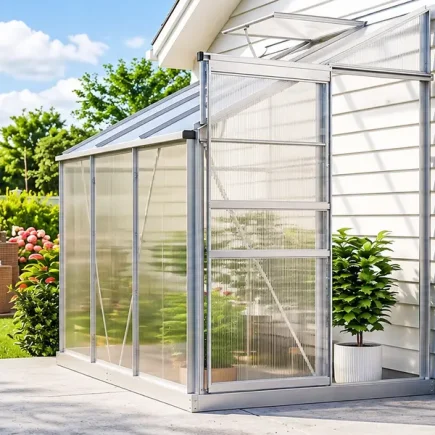
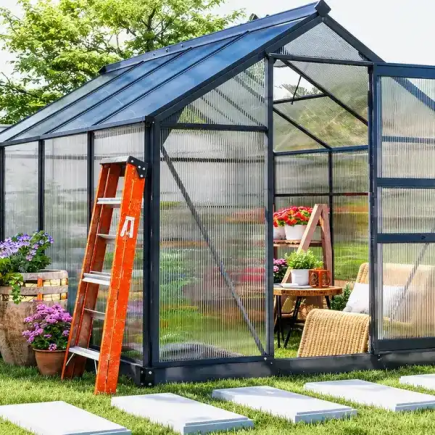
With two roof vents and a sliding door, the Outsunny 6′ x 6′ Polycarbonate Greenhouse is the only one of the three with openings in the roof. Warm air can leave from the highest point while the door lets cooler air in at ground level. It is also the only one of the three with rigid polycarbonate panels instead of a PE cover.
Features:
- Size: 190 x 190 x 200 cm overall, with a 127 cm eave height, the smallest footprint of the three.
- Vents: Two roof vents of 61 x 57 cm, together about 19% of the floor.
- Door: A 62 x 164 cm sliding door, about 28% of the floor, which acts as the low opening.
- Build: 4 mm polycarbonate panels on an aluminum frame with a galvanized steel base.
Pros:
- Each vent holds open at five heights, from 7 cm to 32 cm, so the gap can follow the weather.
- A galvanized base with four ground bolts gives the frame stable support.
- Built-in rain gutters on the sloped roof help stop water building up.
Con:
- It is not designed to withstand extreme weather such as heavy snow, which matters in snowier parts of Canada.
Suited to: Gardeners with a smaller yard who want vents up high where the warm air collects.
Outsunny Roll-Up Sidewall Tunnel, for the Largest Side Openings[2]
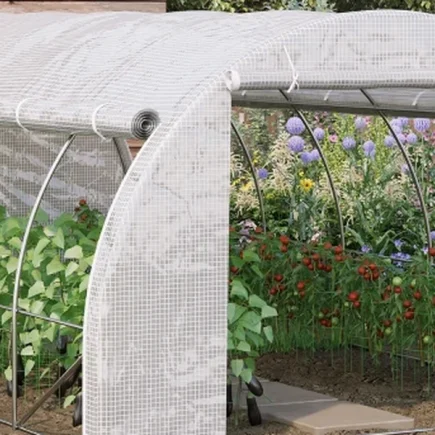
The Outsunny Roll-Up Sidewall Tunnel opens far more of its walls than the other two, with zipped sidewalls that roll up along its length. Each opening has a mesh layer, so the sidewalls, windows and door can stay open while keeping flying insects out. Growers with hoop houses find roll-up sides work well for warm-season ventilation, and this tunnel puts them on its long walls.[4]
Features:
- Size: 200 x 300 x 198 cm overall, the same footprint as the Mesh Window Tunnel.
- Vents: Roll-up sidewalls of 280 x 110 cm each, plus 60 x 40 cm roll-up windows. One sidewall alone equals about 51% of the floor.
- Doors: An outer PE door of 115 x 176 cm and an inner mesh door of 93 x 182 cm.
- Build: A 140 gsm PE cover with a reinforcement grid on a galvanized steel frame.
Pros:
- The included sunshade net blocks up to 80% of harmful UV rays.
- Sixteen U-shaped ground stakes and six guy ropes are included to hold the frame down.
- The extended cover improves airtightness and helps keep weeds from creeping in.
Con:
- There is no roof vent, so warm air has to leave through the sides, windows and doors.
Suited to: Gardeners on an open site who want the widest openings to catch a breeze on hot days.
Outsunny Mesh Window Tunnel, for Screened Cross Ventilation[3]
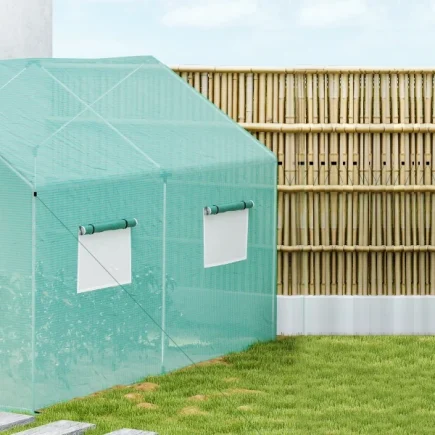
Four mesh-screened windows give the Outsunny Mesh Window Tunnel cross ventilation without opening a whole wall. A wide zipped roll-up door adds the largest single opening, and the pointed two-bay roof helps shed rain and snow. Compared with the Roll-Up Sidewall Tunnel, it trades full sidewalls for smaller screened windows on the same size of floor.
Features:
- Size: 200 x 300 x 200 cm overall.
- Vents: Four windows of 60 x 40 cm with mesh screens, together about 16% of the floor.
- Door: A zipped roll-up door of 100 x 165 cm, about 28% of the floor.
- Build: A two-layer 140 gsm PE cover with a reinforcement grid on a galvanized steel frame.
Pros:
- Up to 85% of sunlight passes through the UV-resistant cover.
- With its extended edges buried and guy ropes staked, it has a Level 4 wind resistance rating.
- Galvanized steel tubing is less likely to rust than standard powder-coated frames.
Con:
- The four windows are its only vents besides the door, so on hot days the door needs to be open too.
Suited to: Gardeners who want screened windows in a walk-in tunnel and can open the door on hot days.
How to Keep Greenhouse Vents Working Well
Vents need to open freely in summer and close tightly in winter.
- Before winter: Adjust each vent so it closes evenly and tightly. Vents that do not close well lose a lot of heat over a Canadian winter.[4]
- In summer: For everyday cooling tips such as shading and misting, seeKeep Your Greenhouse Cool This Summer.
Which Greenhouse Should You Buy?
Start with the shape of the greenhouse your yard suits, then the vent type that fits it.
- 6′ x 6′ Polycarbonate Greenhouse: Best for a smaller yard and vents up in the roof.[1]
- Roll-Up Sidewall Tunnel: Best for the largest openings on a site that catches a breeze.[2]
- Mesh Window Tunnel: Best for a walk-in tunnel with screened windows rather than full sidewalls.[3]
FAQs
Yes. Apart from letting heat out, venting replaces carbon dioxide, which can run low when a greenhouse stays closed.[6]
Not always. Passive airflow through roll-up sides and roof vents is the simplest form of greenhouse ventilation.[7] An exhaust fan moves air through the greenhouse in all weather, which helps on hot, still days.[4]
Multiply the floor area in square feet by 8, and choose a fan rated for about that many cubic feet per minute (CFM) for summer. That gives one full change of air per minute. For the 6′ x 6′ Polycarbonate Greenhouse, it works out to about 310 CFM, and about a quarter of that is enough in winter.[4]
There is no single number, because each crop has its own best range. For tomatoes, Ontario crop guidance gives 18.5 to 26.5°C as the best range for fruit set, so open the vents before the air climbs past the top of it.[5]
References
[1] Aosom Canada. Outsunny 6′ x 6′ x 6.5′ Polycarbonate Greenhouse, Walk-in Green House with Adjustable Roof Vent Galvanized Base Sliding Door Rain Gutter for Outdoor Garden Backyard, Grey.
https://www.aosom.ca/item/outsunny-6-x-6-x-6-5-polycarbonate-greenhouse-walk-in-green-house-with-adjustable-roof-vent-galvanized-base-sliding~1VQ7UGH2K2001.html
[2] Aosom Canada. Outsunny Walk-in Tunnel Greenhouse, Plant Hot House with Sunshade Net, Roll-up Mesh Sidewalls, 2 Doors, 6.6′ x 10′ x 6.5′, Green.
https://www.aosom.ca/item/outsunny-walk-in-tunnel-greenhouse-plant-hot-house-with-sunshade-net-roll-up-mesh-sidewalls-2-doors-6-6-x-10-x-6-5-green~22F4THLUK9O00.html
[3] Aosom Canada. Outsunny 6.6′ x 10′ x 6.6′ Walk-in Tunnel Greenhouse UV-resistant Wind Resistant Green House with Door and Mesh Windows, Green.
https://www.aosom.ca/item/outsunny-walk-in-tunnel-greenhouse-uv-resistant-green-house-with-door-and-mesh-windows-6-6-x-10-x-6-6-green~1KJ2F7FUS2801.html
[4] UMass Extension. Ventilation for Greenhouses.
https://www.umass.edu/agriculture-food-environment/greenhouse-floriculture/fact-sheets/ventilation-for-greenhouses
[5] Ontario Ministry of Agriculture, Food and Agribusiness. Extreme temperature effects on tomato and pepper crops.
https://www.ontario.ca/page/extreme-temperature-effects-tomato-and-pepper-crops
[6] University of Florida IFAS. Venting Systems.
https://propg.ifas.ufl.edu/02-environment/03-temperature/06-temperature-vents.html
[7] Government of British Columbia, Indigenous Greenhouse Factsheets. Greenhouse Internal Infrastructure Systems.
https://www2.gov.bc.ca/assets/gov/farming-natural-resources-and-industry/agriculture-and-seafood/programs/indigenous-agriculture-development/factsheets/greenhouse_internal_infrastructure_systems.pdf